Represent and Destroy
Rationalizing Violence in the New Racial Capitalism
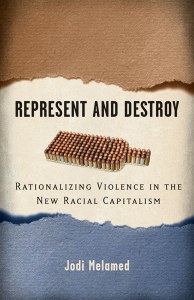
MANIFOLD OPEN ACCESS EDITION
A stinging critique of the link between global capitalism and U.S. multiculturalisms
In the global convulsions in the aftermath of World War II, one dominant world racial order broke apart and a new one emerged. In Represent and Destroy, Jodi Melamed portrays the postwar racial break as a transition from white supremacist modernity to a formally antiracist liberal capitalist modernity in which racial violence works normatively by policing representations of difference.
"A brilliant correction to both Weber and Winant, Represent and Destroy demonstrates how ‘the control over the means of rationality’ characterizes post-World War II US liberal racial orders. Working against the grain of change-as-progress, Jodi Melamed painstakingly demonstrates how official anti-racism has steadied, rather than dissolved, race as a structuring force of capitalism."
—Ruth Wilson Gilmore, author of Golden Gulag: Prisons, Surplus, Crisis and Opposition in Globalizing California
In the global convulsions in the aftermath of World War II, one dominant world racial order broke apart and a new one emerged. This is the story Jodi Melamed tells in Represent and Destroy, portraying the postwar racial break as a transition from white supremacist modernity to a formally antiracist liberal capitalist modernity in which racial violence works normatively by policing representations of difference.
Following the institutionalization of literature as a privileged domain for Americans to get to know difference—to describe, teach, and situate themselves with respect to race—Melamed focuses on literary studies as a cultural technology for transmitting liberal racial orders. She examines official antiracism in the United States and finds that these were key to ratifying the country’s global ascendancy. She shows how racial liberalism, liberal multiculturalism, and neoliberal multiculturalism made racism appear to be disappearing, even as they incorporated the assumptions of global capitalism into accepted notions of racial equality.
Yet Represent and Destroy also recovers an anticapitalist “race radical” tradition that provides a materialist opposition to official antiracisms in the postwar United States—a literature that sounds out the violence of liberal racial orders, relinks racial inequality to material conditions, and compels desire for something better than U.S. multiculturalism.
A brilliant correction to both Weber and Winant, Represent and Destroy demonstrates how ‘the control over the means of rationality’ characterizes post-World War II US liberal racial orders. Working against the grain of change-as-progress, Jodi Melamed painstakingly demonstrates how official anti-racism has steadied, rather than dissolved, race as a structuring force of capitalism.
Ruth Wilson Gilmore, author of Golden Gulag: Prisons, Surplus, Crisis and Opposition in Globalizing California
Melamed . . . offers a powerful revisionary account of racial discourse, literature, and politics since WW II. Melamed's important polemic deserves a wide audience.
Choice
Represent and Destroy is an extremely generative book, and the analytical framework it suggests could be taken up by a wide variety of fields.
darkmatter Journal
She offers exceptionally challenging and hopeful readings...Remarkable.
American Quarterly
Contents
Preface
Introduction: Producing Discourses of Certainty with Official Antiracisms
1. Killing Sympathies: Racial Liberalism and Race Novels
2. Counterinsurgent Canon Wars and Surviving Liberal Multiculturalism
3. Making Global Citizens: Neoliberal Multiculturalism and Literary Value
4. Difference as Strategy in International Indigenous Peoples' Movements
Epilogue: Rematerializing Antiracism
Acknowledgments
Notes
Bibliography
Index