Migrants for Export
How the Philippine State Brokers Labor to the World
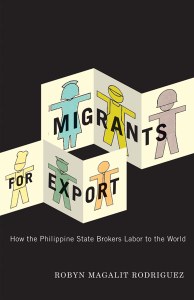
Robyn Magalit Rodriguez investigates how and why the Philippine government transformed itself into what she calls a labor brokerage state, which actively prepares, mobilizes, and regulates its citizens for migrant work abroad. Drawing on ethnographic research of the Philippine government’s migration bureaucracy, interviews, and archival work, Rodriguez presents a new analysis of neoliberal globalization and its consequences for nation-state formation.
Focusing on the state as organizer of migrations makes legible a reality that often remains veiled in the more common attention on migrants and their households. Robyn Magalit Rodriguez shows us the strong articulation of a business and a political logic in the Philippino state’s organized export of workers. Maintaining the loyalty of its annual average million plus exported workers becomes critical for the state’s business side of these exports. Through her study of the extreme case that is the Philippines, Rodriguez makes a major contribution to our understanding of a range of small and big puzzles in the migration literature.
Saskia Sassen, author of Territory, Authority, Rights
Migrant workers from the Philippines are ubiquitous to global capitalism, with nearly 10 percent of the population employed in almost two hundred countries. In a visit to the United States in 2003, Philippine president Gloria Macapagal Arroyo even referred to herself as not only the head of state but also “the CEO of a global Philippine enterprise of eight million Filipinos who live and work abroad.”
Robyn Magalit Rodriguez investigates how and why the Philippine government transformed itself into what she calls a labor brokerage state, which actively prepares, mobilizes, and regulates its citizens for migrant work abroad. Filipino men and women fill a range of jobs around the globe, including domestic work, construction, and engineering, and they have even worked in the Middle East to support U.S. military operations. At the same time, the state redefines nationalism to normalize its citizens to migration while fostering their ties to the Philippines. Those who leave the country to work and send their wages to their families at home are treated as new national heroes.
Drawing on ethnographic research of the Philippine government’s migration bureaucracy, interviews, and archival work, Rodriguez presents a new analysis of neoliberal globalization and its consequences for nation-state formation.
Focusing on the state as organizer of migrations makes legible a reality that often remains veiled in the more common attention on migrants and their households. Robyn Magalit Rodriguez shows us the strong articulation of a business and a political logic in the Philippino state’s organized export of workers. Maintaining the loyalty of its annual average million plus exported workers becomes critical for the state’s business side of these exports. Through her study of the extreme case that is the Philippines, Rodriguez makes a major contribution to our understanding of a range of small and big puzzles in the migration literature.
Saskia Sassen, author of Territory, Authority, Rights
Migrants for Export, which focuses on the Philippine state as a ‘labor brokerage state,’ explores the novel, yet important roles the state has come to play in contemporary migratory processes. Rodriguez makes a timely and fresh argument that offers a provocative way for understanding the place of the state in these processes.
Lieba Faier, author of Intimate Encounters: Filipina Women and the Remaking of Rural Japan
Rodriguez has made an important empirical, theoretical and methodological contribution to labour studies specifically and the social sciences in general.
Global Labour Journal
This book provides another excellent addition to the growing field of Philippine transnational migration studies that should be read by Asianists, sociologists, geographers, political scientists and migration scholars.
Pacific Affairs
At a time when many scholars of migration are turning away from political economy, Rodriguez helps us to better understand migration in relation to the transnational processes of our global epoch.
Science & Society
Migrants for Export should . . . be key reading for anyone wishing to understand the institutional dynamics that suture together personal histories and global structural forces.
Signs
Migrants for Export is not only an important contribution to scholarship on migration and labour. It also challenges analyses which suggest that states are no longer significant players in a globalized and transnational world. This book deserves to be read in a wide range of disciplines at university and college levels, as well as by organizers and activists involved in immigration and labour (in)justice struggles.
Labour/Le Travail
Rodriguez exact[s] a calculated and forceful critique against the systems of capitalism that broker labor and commodify people. Useful for any scholar looking to critique neoliberal globalization in addition to any student learning about neoliberalism’s impact on the world.
Critical Sociology
9/22/2010
Despite an unprecedented global economic crisis, Filipinos are leaving the Philippines in the thousands for employment in hundreds of countries overseas.
It seems rather paradoxical; how is it possible for people from the Philippines to migrate during a period of crisis?