Digital Baroque
New Media Art and Cinematic Folds
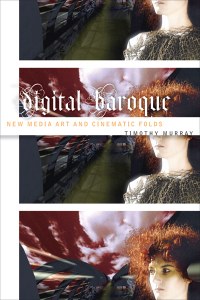
Making an exquisite and unexpected connection between the old and the new, Digital Baroque analyzes the philosophical paradigms that inform contemporary screen arts. Examining a wide range of art forms, Murray reflects on the rhetorical, emotive, and social forces inherent in the screen arts’ dialogue with early modern concepts.
In the flood of recent publications on electronic and digital art, nothing can compare to Digital Baroque—a work of tremendous originality, conceived and written with great clarity, commitment, and wit.
D. N. Rodowick, author of The Virtual Life of Film
In this intellectually groundbreaking work, Timothy Murray investigates a paradox embodied in the book’s title: What is the relationship between digital, in the form of new media art, and baroque, a highly developed early modern philosophy of art? Making an exquisite and unexpected connection between the old and the new, Digital Baroque analyzes the philosophical paradigms that inform contemporary screen arts.
Examining a wide range of art forms, Murray reflects on the rhetorical, emotive, and social forces inherent in the screen arts’ dialogue with early modern concepts. Among the works discussed are digitally oriented films by Peter Greenaway, Jean-Luc Godard, and Chris Marker; video installations by Thierry Kuntzel, Keith Piper, and Renate Ferro; and interactive media works by Toni Dove, David Rokeby, and Jill Scott. Sophisticated readings reveal the electronic psychosocial webs and digital representations that link text, film, and computer.
Murray puts forth an innovative Deleuzian psychophilosophical approach—one that argues that understanding new media art requires a fundamental conceptual shift from linear visual projection to nonlinear temporal folds intrinsic to the digital form.
In the flood of recent publications on electronic and digital art, nothing can compare to Digital Baroque—a work of tremendous originality, conceived and written with great clarity, commitment, and wit.
D. N. Rodowick, author of The Virtual Life of Film
Any reader interested in new media art and a state of the art overview of philosophical thinking on the subject will find Digital Baroque a sure guide to what to see and what to read in today’s screen art.
Leonardo Reviews
The book provides a new slant on Deleuze’s film theory, refracted through his concept of the Baroque, and offers some valuable suggestions on how to take the concept of a ‘time image’ beyond the medium of traditional cinema.
Film-Philosophy
Murray designs a stimulating path through his analysis.
The Information Society
With Digital Baroque, Murray performs an equivalent conceptual folding, with ‘new media’ established—across three hundred-plus pages and several centuries—as offering a revealing glimpse of cinema’s simultaneous passing and rebirth.
Film Quarterly
Digital Baroque tests the bounds of previous theoretical criticism by creating an artwork that simultaneously critically discusses theory and demonstrates that theory.
Rhizomes