Connected, or What It Means to Live in the Network Society
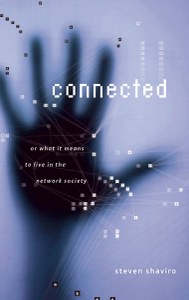
Connected is made up of a series of mini-essays—on cyberpunk, hip-hop, film noir, Web surfing, greed, electronic surveillance, pervasive multimedia, psychedelic drugs, artificial intelligence, and evolutionary psychology, among other topics. In this breathtaking work, Steven Shaviro investigates popular culture, new technologies, political change, and community disruption and concludes that science fiction and social reality have become virtually indistinguishable.
These intelligent, entertaining, and intricate readings of our cultural superstructure—the sci-fi of Jeter, Dick, and Gibson, the hayday of Napster and the early years of all-but-total web freedom—now and again cast a harsh slant-light on the infrastructure that holds so much contemporary misery in place. This is a book to keep the mind agile and the spirit lively.
Samuel R. Delany, author of 1984 and The Mad Man
In the twenty-first century, a network society is emerging. Fragmented, visually saturated, characterized by rapid technological change and constant social upheavals, it is dizzying, excessive, and sometimes surreal. In this breathtaking work, Steven Shaviro investigates popular culture, new technologies, political change, and community disruption and concludes that science fiction and social reality have become virtually indistinguishable.
Connected is made up of a series of mini-essays-on cyberpunk, hip-hop, film noir, Web surfing, greed, electronic surveillance, pervasive multimedia, psychedelic drugs, artificial intelligence, evolutionary psychology, and the architecture of Frank Gehry, among other topics. Shaviro argues that our strange new world is increasingly being transformed in ways, and by devices, that seem to come out of the pages of science fiction, even while the world itself is becoming a futuristic landscape. The result is that science fiction provides the most useful social theory, the only form that manages to be as radical as reality itself.
Connected looks at how our networked environment has manifested itself in the work of J. G. Ballard, William S. Burroughs, Philip K. Dick, William Gibson, K. W. Jeter, and others. Shaviro focuses on science fiction not only as a form of cultural commentary but also as a prescient forum in which to explore the forces that are morphing our world into a sort of virtual reality game. Original and compelling, Connected shows how the continual experimentation of science fiction, like science and technology themselves, conjures the invisible social and economic forces that surround us.
These intelligent, entertaining, and intricate readings of our cultural superstructure—the sci-fi of Jeter, Dick, and Gibson, the hayday of Napster and the early years of all-but-total web freedom—now and again cast a harsh slant-light on the infrastructure that holds so much contemporary misery in place. This is a book to keep the mind agile and the spirit lively.
Samuel R. Delany, author of 1984 and The Mad Man
Shaviro's theoretical fictions lead us through a Borgesian labyrinth of the networked psyche, a virtual schizopolis populated by the purveyors of an emergent artificial intelligentsia. Like a DJ theorist spinning new ideas, he plays the citational remix game and reminds us that being hyperlinked to the Virtual Motherboard is part of the addictive lifestyle choice that has become our common nature.
Mark Amerika, author of The Kafka Chronicles
Connected’s eclecticism is so wide-ranging as to be nearly peripatetic, embracing such subjects as the way different kinds of drugs produce behavior that fits ‘masculine’ or ‘feminine’ gender roles; what’s wrong with notions that biological evolution is goal-directed; or the ways in which vampires, zombies, and the many-tentacled horrors of H.P. Lovecraft evoke different models of the relation between labor and capital. Shaviro pulls all the strands together, and foregrounds the network society as the nexus that links all the other points he’s made.
Rain Taxi
Shaviro has examined an astonishing range of cultural texts and has invariably brought a fresh, intelligent perspective to bear on each.
Science Fiction Studies
Contents
Preface
Acknowledgments
Connected, or What It Means to Live in the Network Society
Notes
Bibliography
Filmography
Index