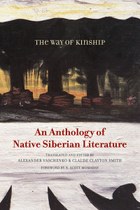
The Way of Kinship
An Anthology of Native Siberian Literature
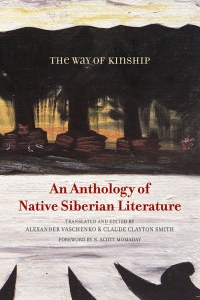
Drawn from seven distinct ethnic groups, this diverse body of work—prose fiction, poetry, drama, and creative nonfiction—chronicles ancient Siberian cultures and traditions threatened with extinction in the contemporary world. Translated and edited by Alexander Vaschenko and Claude Clayton Smith, The Way of Kinship is an essential collection that will introduce readers to new writers and new worlds.
Around the globe traditional cultures are being destroyed by greedy commercial interests and insensitive government policies. In The Way of Kinship a variety of ethnic Siberian writers reveal the consequences of such policies on their way of life. This book is a call to action! We cannot allow the final destruction of the Siberian cultures, or of the world’s remaining traditional cultures. I am extremely grateful these writers have told their stories, and thankful the editors have presented this most important anthology.
Rudolfo Anaya
“That these treasures are available to us as writing is a miracle. . . . The writings here, while altogether modern in one sense, are based on a literature, albeit oral, that has existed for thousands of years. They are the reflections of people who have lived long on the earth, on their own terms, in harmony with the powers of nature. They are invaluable to us who have so much to learn from them. These stories, poems, songs give us a way, a sacred way, into a world that we ought to know for its own sake. It is our own world, after all.” —N. Scott Momaday, from the Foreword
The first anthology of Native Siberian literature in English, The Way of Kinship represents writers from regions extending from the Ob River in the west to the Chukotka peninsula, the easternmost point of the Siberian Russian Arctic. Drawn from seven distinct ethnic groups, this diverse body of work—prose fiction, poetry, drama, and creative nonfiction—chronicles ancient Siberian cultures and traditions threatened with extinction in the contemporary world.
Translated and edited by Alexander Vaschenko and Claude Clayton Smith, leading scholars in Native Siberian literature, The Way of Kinship is an essential collection that will introduce readers to new writers and new worlds.
Around the globe traditional cultures are being destroyed by greedy commercial interests and insensitive government policies. In The Way of Kinship a variety of ethnic Siberian writers reveal the consequences of such policies on their way of life. This book is a call to action! We cannot allow the final destruction of the Siberian cultures, or of the world’s remaining traditional cultures. I am extremely grateful these writers have told their stories, and thankful the editors have presented this most important anthology.
Rudolfo Anaya
The Way of Kinship will provide a good resource for courses in comparative literature, ethnic diversity, ethnic literatures, cultural understanding, cultural anthropology, and environmental studies. . . . Any general reader interested in ethnic literatures or new aesthetic experiences will find the content of this unique anthology fascinating.
Journal of Folklore Research
Like all powerful literature, this is work that rewards revisits and offers complex layers of meanings. The literary quality is very high.
Sibirica
An important step in cataloging the richness of Russia’s eastern literary tradition, which is a vastly understudied genre in Russian literature.
IPIR: Indigenous Peoples Issues & Resources
Contents
Foreword
N. Scott Momaday
Introduction. Cry of the Wild Crane: The Call of Forgotten Kinship
Alexander Vaschenko
Evenk Invocation for Good Fortune: To Nature, When the Earth Turns Green
Yeremei Aipin (Khanty)
Old Man Moon
The Earth’s Pain
Puzzles of My Childhood
Selections from Morning Twilight: A Novel of the Khanty
And So Dies My Clan
Nadezda Taligina (Khanty)
A Portfolio of Ten Drawings
Yuri Vaella (Taiga Nenets)
At The Bus Stop
Watching TV
On Things Eternal
To the Bear
Song of the Reindeer Breeder
Eternal Sky
The Little Shaman and other Stories
Morning at the Lake
Fyodor the Hunter
New from Vatyegan Camp
Galina Keptuke (Evenk)
A Discovery
The Unexpected Guest
Little America
Gennady Dyachkov (Yukagir)
The Hunter’s Son: A One-Act Play
Vladimir Sangi (Nivkh)
My First Shot
Maria Vagatova (Khanty)
My Word, My Tongue
River Mosum, My Water
Dirge for the Land of the Khanty
The People of Tuk’yakang Village
Stone Soldier
An Old Anthill
Gennady Raishev (Khanty)
Four Black and White Prints
Jansi Kimonko (Udegeh)
From Where the Sukpai Rushes Along
Anna Nerkagi (Tundra Nenets)
From The Horde
Leonty Taragupta (Khanty)
Son of the Sky
The Prayer of the Bear
Yuri Rytkheu (Chukchee)
Kakot’s Numbers
Evenk Invocation for Good Fortune: To Nature, When the Green Recedes
A Note on Translation
Claude Clayton Smith
Acknowledgments
Suggestions for Further Reading
UMP blog posts (December 2010):
Part One: Anthology triggers dialogue between Native American and Native Siberian literary traditions.
Q: What were your goals for this anthology?
I had three main goals for The Way of Kinship. First, as a specialist in American Studies, I have always been dissatisfied with the one-sidedness, misinterpretation, or lack of knowledge of Russian cultural and literary phenomena in the United States. One reason for that is the gap between the primary material in the texts and what is chosen—if at all—to be translated into English. As time goes by, this gap only widens. With The Way of Kinship I wanted to acquaint American readers with one of the lesser-known but important Russian language literary traditions—that of Native Siberian literature.
How did you and Dr. Vaschenko begin working together?
I am glad to be asked this question, because the answer is a matter of serendipity and fate.
In October of 1989 an international Hemingway conference was held at Ohio Northern University in Ada, Ohio, where I was a professor in the English Department. The conference was directed by my friend and colleague, Dr. Charles “Tod” Oliver, editor of the (then) fledgling Hemingway Review. One of the topics at that conference was “Native Americans in the Works of Ernest Hemingway,” and one of the scholars in attendance was Alexander Vaschenko, the Russian authority on Native American literature and folklore. Dr. Vaschenko had come with a contingent of six professors from the A.M. Gorky Institute of World Literature of the Russian National Academy of Sciences.