The Scar of Visibility
Medical Performances and Contemporary Art
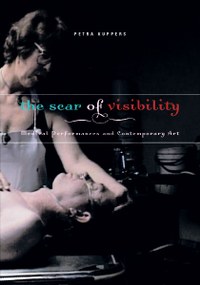
In The Scar of Visibility, Petra Kuppers examines the use of medical imagery practices in contemporary art, as well as different arts of everyday life. Among the works she investigates are the controversial Body Worlds exhibition of plastinized corpses, films like David Cronenberg's Crash that fetishize body wounds, representations of the AIDS virus on CSI: Crime Scene Investigations, and the paintings of outsider artist Martin Ramírez.
Ambitious in scope, yet grounded in strong analytic skills for reading performance, The Scar of Visibility offers a powerful interrogation of contemporary conceptualizations of the body in both science and art.
Susan Foster, author of Dances That Describe Themselves
Contemporary visual and performance artists have adopted modern medical technologies such as MRIs and computer imaging—and the bodily access they imply—to reveal their limitations. In doing so they emphasize the unknowability of another’s bodily experience and the effects—physical, emotional, and social—of medical procedures.
In The Scar of Visibility, Petra Kuppers examines the use of medical imagery practices in contemporary art, as well as different arts of everyday life (self-help groups, community events, Internet sites), focusing on fantasies and “knowledge projects” surrounding the human body. Among the works she investigates are the controversial Body Worlds exhibition of plastinized corpses; video projects by Shimon Attie on diabetes and Douglas Gordon on mental health and war trauma; performance pieces by Angela Ellsworth, Bob Flanagan, and Kira O’Reilly; films like David Cronenberg’s Crash and Marina de Van’s In My Skin that fetishize body wounds; representations of the AIDS virus in the National Museum of Health and on CSI: Crime Scene Investigations; and the paintings of outsider artist Martin Ramírez.
At the heart of this work is the scar—a place of production, of repetition and difference, of multiple nerve sensations, fragile skin, outer sign, and bodily depth. Through the embodied sign of the scar, Kuppers articulates connections between subjective experience, history, and personal politics. Illustrated throughout, The Scar of Visibility broadens our understanding of the significance of medical images in visual culture.
Ambitious in scope, yet grounded in strong analytic skills for reading performance, The Scar of Visibility offers a powerful interrogation of contemporary conceptualizations of the body in both science and art.
Susan Foster, author of Dances That Describe Themselves
Kuppers's longstanding experience with and inquiry into disability means that her approach to medical imagery is rooted in lived experience and seasoned by long-term thought. This is not a 'fad' turn to the topic, but a deeply invested engagement.
Rebecca Schneider, Brown University
The works Kuppers analyzes are compelling and fascinate the reader all the more when juxtaposed against one another. Her fresh comparisons make for a thought-provoking analysis which will appeal to those in art, performance, disability studies, and cultural studies.
Journal of Popular Culture
Contents
Acknowledgments
Introduction: Bodily Fantasies
1. Visions of Anatomy: Space, Exhibitions, and Dense Bodies
2. Living Bodies: Staging Knowledge, Fantasy, and Temporality
3. The Collaborative Arts: Pain and Performance
4. Intersections: Blood, Laughter, and the Space-O,
5. Monsters, Cyborgs, Animals: Crashes, Cuttings, and Migraines
6. Medical Museums and Art Display: The Discourses of AIDS
7. Reaching Out: Outsider Art, Specialists, and Positions in Between
Epilogue: Fantasies in the Sand
Notes
Bibliography
Index