The Ethnic Canon
Histories, Institutions, and Interventions
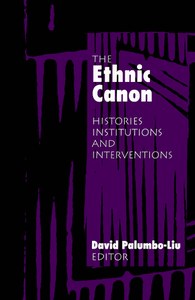
David Palumbo-Liu, editor
Argues that texts are added to the canon only after an operation that attempts to resolve and neutralize historical and political contradictions and differences. The Ethnic Canon offers a wide variety of critical viewpoints and is unique in its pointed critique of the academy regarding specific authors and texts that have and have not been included in the canon.
Contributors include Norma Alarcón, Paula Gunn Allen, Elliott Butler-Evans, Barbara Christian, Lisa Lowe, Colleen Lye, Ramón Saldívar, E. San Juan Jr., Rosaura Sánchez, Jana Sequoya-Magdaleno, and Sau-ling Cynthia Wong
This collection of 11 essays by prominent ethnic-studies scholars represents the best of recent critical views about the inclusion of ethnic literatures in the curriculum.
Choice
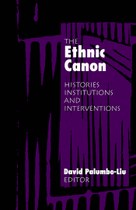
Who determines what ethnic literature gets included in the standard educational canon? How does this decision making occur? The Ethnic Canon questions the current process, arguing that texts are added to the canon only after an operation that attempts to resolve and neutralize historical and political contradictions and differences.
The Ethnic Canon offers a wide variety of critical viewpoints and speaks to the history and practice of canon formation within specific ethnic literatures. It is a unique collection in its pointed critique of the academy regarding particular authors and texts that have and have not been included in the canon. The texts examined include Toni Morrison's Song of Solomon, Ralph Ellison's Invisible Man, Américo Paredes's Between Two Worlds, Richard Rodriquez's Days of Obligation, and David Henry Hwang's M. Butterfly, along with the novels of Amy Tan, Filipino works, and Caribbean women's writings.
Contributors include Norma Alarcón, University of California, Berkeley; Paula Gunn Allen, University of California, Los Angeles; Elliott Butler-Evans, University of California, Santa Barbara; Barbara Christian, University of California, Berkeley; Lisa Lowe, University of California, San Diego; Colleen Lye, Columbia University; Ramón Saldívar, Stanford University; E. San Juan Jr., University of Connecticut, Storrs; Rosaura Sánchez, University of California, San Diego; Jana Sequoya-Magdaleno, Stanford University; and Sau-ling Cynthia Wong, University of California, Berkeley.
$32.50 paper ISBN 978-0-8166-2557-4
312 pages, 5 7/8 x 9, 1995
David Palumbo-Liu is assistant professor of comparative literature at Stanford University.
This collection of 11 essays by prominent ethnic-studies scholars represents the best of recent critical views about the inclusion of ethnic literatures in the curriculum.
Choice
This set of studies offers up a sharp, hard-edged critique of the institutionalization of ethnic studies in the modern university from a left-academic position.
American Literature

About This Book
Related Publications
The New American Studies
A clarion call for a more theoretically and politically informed approach to American Studies
Urban Triage
Race and the Fictions of Multiculturalism
Assesses fictional representations of racial conflict, cooperation, and complicity amid the urban crisis of the 1980s
Against Literature
Is there a way of thinking about literature that is “outside” or “against” literature? In Against Literature, John Beverly brilliantly responds to this question, arguing for a negation of the literary that would allow nonliterary forms of cultural practice to displace literature’s hegemony.
DisForming the American Canon
African-Arabic Slave Narratives and the Vernacular
Judy offers an alternative interpretation of literacy that challenges traditional Enlightenment discourse’s claim that literacy and reason are the privileged properties of Western culture. Judy argues, on the basis of his readings of autobiographical African-American Arabic slave narratives, that through the production of the Arabic text, the African slave already had all the elements that the West attributes to “reason” before his original introduction to Western culture-a literacy that already mediated between Africa and Europe.
“Has the potential to completely remake American Studies while serving as an excellent example of what theoretical informed criticism should be.” --Paul Bové
Creating American Civilization
A Genealogy of American Literature as an Academic Discipline
“‘American literature’ seems by now so natural and inevitable an entity that we forget that it did not just grow organically out of American soil, much less spring full blown from the minds of a few geniuses. In this highly readable study, David Shumway recovers the forgotten social, historical, and institutional conditions that explain why the concepts both of ‘literature’ and of distinctive literary Americanness emerged together at a particular time and place and how their merger reshaped America's educational vision. Shumway has written a penetrating and provocative account of the making of American Civilization as an academic field.” --Gerald Graff, University of Chicago