The Dance That Makes You Vanish
Cultural Reconstruction in Post-Genocide Indonesia
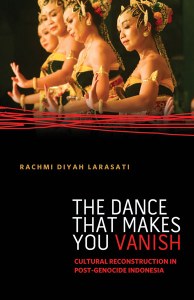
Indonesian court dance is famed for its sublime calm and stillness, yet this peaceful surface conceals a time of political repression and mass killing. Rachmi Diyah Larasati reflects on her own experiences as an Indonesian national troupe dancer from a family of persecuted female dancers and activists, examining the relationship between female dancers and the Indonesian state since 1965.
Women’s bodies, dancing bodies: in this haunting book, they lead us to political terror and its erasure in safely contained cultural performance. The ghosts of dancers killed in state-sponsored anti-communist frenzy shimmer before us, their movements precisely replicated by their state-cleansed replacements. Memoir here winds in and out of cultural critique; we are led up to that vanishing point where power and violence tear their way into the heart.
Anna Tsing, author of Friction: An Ethnography of Global Connection
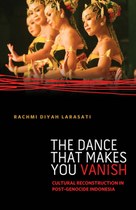
Indonesian court dance, a purportedly pure and untouched tradition, is famed throughout the world for its sublime calm and stillness. Yet this unyieldingly peaceful surface conceals a time of political repression and mass killing. Between 1965 and 1966, some one million Indonesians—including a large percentage of the country’s musicians, artists, and dancers—were killed, arrested, or disappeared as Suharto established a virtual dictatorship that ruled for the next thirty years.
In The Dance That Makes You Vanish, an examination of the relationship between female dancers and the Indonesian state since 1965, Rachmi Diyah Larasati elucidates the Suharto regime’s dual-edged strategy: persecuting and killing performers perceived as communist or left leaning while simultaneously producing and deploying “replicas”—new bodies trained to standardize and unify the “unruly” movements and voices of those vanished—as idealized representatives of Indonesia’s cultural elegance and composure in bowing to autocratic rule. Analyzing this history, Larasati shows how the Suharto regime’s obsessive attempts to control and harness Indonesian dance for its own political ends have functioned as both smoke screen and smoke signal, inadvertently drawing attention to the site of state violence and criminality by constantly pointing out the “perfection” of the mask that covers it.
Reflecting on her own experiences as an Indonesian national troupe dancer from a family of persecuted female dancers and activists, Larasati brings to life a powerful, multifaceted investigation of the pervasive use of culture as a vehicle for state repression and the global mass-marketing of national identity.
Women’s bodies, dancing bodies: in this haunting book, they lead us to political terror and its erasure in safely contained cultural performance. The ghosts of dancers killed in state-sponsored anti-communist frenzy shimmer before us, their movements precisely replicated by their state-cleansed replacements. Memoir here winds in and out of cultural critique; we are led up to that vanishing point where power and violence tear their way into the heart.
Anna Tsing, author of Friction: An Ethnography of Global Connection
Crafted with rigor and generosity.
Indonesia Journal
Anthropological Quarterly
Beautifully written and theoretically rich.
Women’s Studies Quarterly
The Dance That Makes You Vanish is an important and long awaited book on the history of genocide, through the experiences of an insider living behind the beautiful and artistic exterior of a rich and long tradition of ritual dances.
Journal of Contemporary Asia
Contents
Acknowledgments
Introduction: Dancing on the Mass Grave
1. To Remember Differently: Paradoxical Statehood and Preserved Value
2. What Is Left: The Fabricated and the Illicit
3. Historicizing Violence: Memory and the Transmission of the Aesthetic
4. Staging Alliances: Cambodia as Cultural Mirror
5.Violence and Mobility: Autoethnography of Coming and Going
Notes
Index