Samurai among Panthers
Richard Aoki on Race, Resistance, and a Paradoxical Life
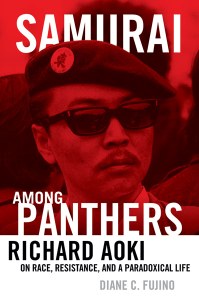
An iconic figure of the Asian American movement, Richard Aoki (1938–2009) was also, as the most prominent non-Black member of the Black Panther Party, a key architect of Afro-Asian solidarity in the 1960s and ’70s. His life story exposes the personal side of political activism as it illuminates the history of ethnic nationalism and radical internationalism in America.
My friend Richard Aoki was there when Huey P. Newton and I founded our Black Panther Party, discussing political analysis and seeking critique approval of our Ten Point Program. This book is a necessary kind of reading that illuminates my friend’s political revolutionary life’s meaning: Richard Aoki’s reverence.
Bobby Seale, founding Chairman and National Organizer of the Black Panther Party
An iconic figure of the Asian American movement, Richard Aoki (1938–2009) was also, as the most prominent non-Black member of the Black Panther Party, a key architect of Afro-Asian solidarity in the 1960s and ’70s. His life story exposes the personal side of political activism as it illuminates the history of ethnic nationalism and radical internationalism in America.
A reflection of this interconnection, Samurai among Panthers weaves together two narratives: Aoki’s dramatic first-person chronicle and an interpretive history by a leading scholar of the Asian American movement, Diane C. Fujino. Aoki’s candid account of himself takes us from his early years in Japanese American internment camps to his political education on the streets of Oakland, to his emergence in the Black Panther Party. As his story unfolds, we see how his parents’ separation inside the camps and his father’s illegal activities shaped the development of Aoki’s politics. Fujino situates his life within the context of twentieth-century history—World War II, the Cold War, and the protests of the 1960s. She demonstrates how activism is both an accidental and an intentional endeavor and how a militant activist practice can also promote participatory democracy and social service.
The result of these parallel voices and analysis in Samurai among Panthers is a complex—and sometimes contradictory—portrait of a singularly extraordinary activist and an expansion and deepening of our understanding of the history he lived.
My friend Richard Aoki was there when Huey P. Newton and I founded our Black Panther Party, discussing political analysis and seeking critique approval of our Ten Point Program. This book is a necessary kind of reading that illuminates my friend’s political revolutionary life’s meaning: Richard Aoki’s reverence.
Bobby Seale, founding Chairman and National Organizer of the Black Panther Party
Richard Aoki straddled the worlds of ethnicity by the radical bridge he built through his engagement with an authentic, even saucy American radicalism. Diane C. Fujino unearths Richard’s story with sympathy and warmth, and in the process redeems the legacy of a remarkable American radical.
Vijay Prashad, author of The Darker Nations: A People's History Of The Third World
Samurai among Panthers is a bracing, honest, and revealing biography. The book is a powerful reminder that although social movements operate collectively within social and political contexts, they are ultimately enacted by individuals who, like Richard Aoki, are flawed, complicated, dedicated, and visionary.
Daryl J. Maeda, author of Rethinking the Asian American Movement
This book makes a significant contribution to the literature on this important period.
Libya 360
From relative obscurity, the unusual life of Richard Aoki is finally being recovered and acknowledged for his integral roles in the Black Panther Party, the Asian American Movement and building Third World solidarity . . . Fujino’s analytical introduction and epilogue provide a strong context to Aoki’s voice. Her thorough endnotes and comprehensive bibliography are excellent guides for activists who seek to apply the past to present and future struggles.
International Examiner
Samurai Among Panthers: Richard Aoki on Race, Resistance, and a Paradoxical Life by Diane C. Fujino is no conventional biography. Aoki was the most prominent non-African American member of the Black Panther Party, and his biography is fascinating, educational, inspiring — in short, hard to put down.
The Rafu Shimpo
Diane C. Fujino’s biography on the iconic Asian American activist Richard Aoki is revealing, fascinating, and at times intensely moving.
Hyphen
Breaks new ground... not only for focusing on an undertreated subject, but also for her decision to publish this work as both autobiography and historical scholarship. ... This important contribution highlights the role of the Asian American Movement in the 1960s and places the BPP itself in a new light.
Choice
Diane Fujino’s Samurai among Panthers: Richard Aoki on Race, Resistance, and a Paradoxical Life is a timely biography that illuminates the life of an extraordinary man whose political activism spanned decades and influenced both ethnic nationalism and radical internationalism movements.
Asian Affairs
With her gripping study and oral history of the Japanese American radical Richard Aoki, Diane Fujino has further cemented herself as a premier scholar of the Vietnam War-era Asian American movement for community empowerment and social justice.
Journal of Asian American Studies
Contents
Abbreviations
Introduction: Demystifying the Japanese Radical Cat
1. “My Happy Childhood That I Don’t Remember”
Disrupting the Deviant–Noble Binary
2. “Protecting the Japanese”
The Ungrieved Trauma of Internment
3. “Learning to Do the West Oakland Dip”
Masculinity, Race, and Citizenship in Postwar Oakland
4. “I Was a Man by the Standards of the ’Hood”
Military Misadventures and Cold War Masculinity
5. “My Identification Went with the Aspirations of the Masses”
The Old Left, Third World Radicalism, and Vietnam
6. “The Greatest Political Opportunity of My Life”
Joining the Black Panther Party
7. “Support All Oppressed Peoples”
Founding the Asian American Political Alliance
8. “Learning to Fly on the Way Down”
The TWLF Strike and the Duality of Education
9. “A Community-Oriented Academic Unit”
The Birth of Asian American Studies
10. “An Advocate for the Students”
The Counselor, Instructor, and Administrator
11. “At Least I Was There”
A Rebirth in Activism for Freedom, Justice, and Equality
Epilogue: Reflecting on a Movement Icon
Acknowledgments
Notes
Bibliography
Index
UMP blog - Remembering Richard Aoki (Nov. 20, 1938 - March 15, 2009)
It’s been three years since Richard Aoki passed away. I was in Berkeley, California, that weekend in March 2009 celebrating the 40th anniversaries of UC Berkeley’s Third World Liberation Front strike and the formation of the Asian American Political Alliance. Richard was perhaps the most prominent Asian American organizer of the Third World strike that gained ethnic studies, a leader of the early Asian American Movement, and the highest ranking non-Black in the Black Panther Party (BPP). Richard’s presence filled the various rooms, with talk of his “bad ass” militancy and courage, of his exploits against the police, and of his Black oratory style. But I also remember Richard’s vulnerability. That weekend, he was a few miles away in a hospital, struggling with kidney failure, heart problems, and other complications. On March 15, 2009, I was sitting in the San Francisco airport awaiting my flight home when I received the phone call that Richard had died at the age of 70.