Sacred Revolutions
Durkheim and the Collège de Sociologie
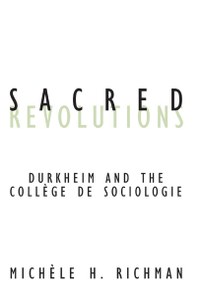
It seems improbable, but the most radical cultural iconoclasts of the interwar years—Georges Bataille, Roger Caillois, and Michel Leiris—responded to the rise of fascism by taking refuge in a "sacred sociology." Michèle H. Richman examines this seemingly paradoxical development in this book which traces the overall implications for French social thought of the "ethnographic detour" that began with Durkheim’s interest in Australian aboriginal religion—implications that reach back to the Revolution of 1789 and forward to the student protests of May 1968.
Contradictions Series, volume 14
Sacred Revolutions is a well-researched, dense, and extremely rich study of French sociology and its historical, cultural aftermath. . . . Richman’s book is among the first to examine in depth the complicated genealogy of French sociology from Durkheim to the avant-garde. . . . Sacred Revolutions clearly opens a new area in comparative studies, provoking many curious, unexplored questions about modernism, postmodernism, critical theory, and intellectual history.
Bryn Mawr, Review of Comparative Literature
How is it that the most radical cultural iconoclasts of the interwar years—Georges Bataille, Roger Caillois, and Michel Leiris—could have responded to the rise of fascism by taking refuge in a "sacred sociology"? This is the question that Michèle H. Richman poses in a work that examines this seemingly paradoxical development. Her book traces the overall implications for French social thought of the "ethnographic detour" that began with Durkheim’s interest in Australian aboriginal religion—implications that reach back to the Revolution of 1789 and forward to the student protests of May 1968.
Richman argues that by revising a phenomenon at once as familiar and as exotic as the sacred, these intellectuals forged a point of view relevant to politics, art, and eroticism in the modern period. Assimilating sociology to this revised notion of the sacred, they revitalized a critical discourse based on anthropological thinking dating back to Montaigne and culminating in Rousseau. Her work thus supplies an important chapter in the history of the human sciences while demonstrating the formation of an innovative critical discourse that straddles literary theory, social thought, and religious and cultural studies.
Sacred Revolutions is a well-researched, dense, and extremely rich study of French sociology and its historical, cultural aftermath. . . . Richman’s book is among the first to examine in depth the complicated genealogy of French sociology from Durkheim to the avant-garde. . . . Sacred Revolutions clearly opens a new area in comparative studies, provoking many curious, unexplored questions about modernism, postmodernism, critical theory, and intellectual history.
Bryn Mawr, Review of Comparative Literature
Contents
Preface and Acknowledgments
Introduction Why Sociology?
1. Durkheim’s Sociological Revolution
2. Savages in the Sorbonne
3. Politics and the Sacred in the Collège de Sociologie
4. Sacrifice in Art and Eroticism
Postscriptum Effervescence from May ’68to the Present
Notes
Index