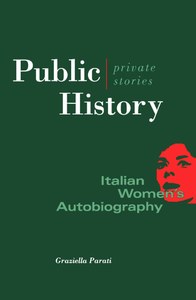
Public History, Private Stories
Italian Women’s Autobiography
Parati examines the ways in which Italian women writers articulate their identities through autobiography—a public act that is also the creation of a private life. Considering autobiographical writings by five women writers from the seventeenth century to the present, Parati draws important connections between self-writing and the debate over women’s roles, both traditional and transgressive.
Public History, Private Stories succeeds in bringing Italian literature and culture squarely into the space of some of today’s most important debates regarding the writing of the self, the place and role of women’s literature, and the usefulness of informed feminist approaches to literary, cultural, and socio-political problematics that are part of transnational scholarship at its best.
Rebecca West, University of Chicago
In this important volume, Graziella Parati examines the ways in which Italian women writers articulate their identities through autobiography—a public act that is also the creation of a private life. Considering autobiographical writings by five women writers from the seventeenth century to the present, Parati draws important connections between self-writing and the debate over women’s roles, both traditional and transgressive.
Parati considers the first prose autobiography written by an Italian woman -Camilla Faà Gonzaga’s 1622 memoir—as her beginning point, citing it as a central “pre-text.” In her memoir, Gonzaga makes explicit her conflict over the public silence imposed on her, yet succeeds in writing herself into history through self-narrative. Parati then examines Enif Robert’s autobiography, in which Robert strives to enter the public sphere of the post-World War I futurist movement by writing about her fight to overcome cancer of the uterus. Next, Parati considers Fausta Cialente’s life story, an account of her family's life in Trieste from World War I through the fascist era, as well as the narrative in which Rita Levi Montalcini describes her life as a woman, a Nobel-Prize winning scientist, and a Jew who lived under fascism in the thirties and forties. Finally, Parati analyzes Luisa Passerini's look back on her involvement with the student movement of 1968.
Through her discussion of these women’s writings, Parati demonstrates the complex negotiations over identity contained within them, negotiations that challenge dichotomies between male and female, maternal and paternal, and private and public. Public History, Private Stories is a compelling exploration of the disparate identities created by these women through the act of writing autobiography.
Public History, Private Stories succeeds in bringing Italian literature and culture squarely into the space of some of today’s most important debates regarding the writing of the self, the place and role of women’s literature, and the usefulness of informed feminist approaches to literary, cultural, and socio-political problematics that are part of transnational scholarship at its best.
Rebecca West, University of Chicago
Parati reconstructs the intricate paths through the private and public, maternal and paternal, and male and female aspects of these women’s experiences and identities through and by which their autobiographical representations of self came to be.
VIA, Voices in Italian America
A very keen analysis of the gendered self in five Italian women’s autobiographies.
The European Legacy