Private Lives, Proper Relations
Regulating Black Intimacy
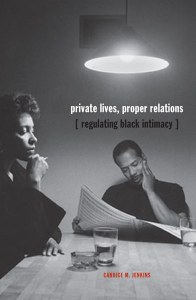
Private Lives, Proper Relations addresses the question of why contemporary African American literature—particularly that produced by black women—is continually concerned with issues of respectability and propriety. Candice M. Jenkins argues that this preoccupation has its origins in ideologies about African American sexuality and expresses an often unarticulated link between the intimate and the political in black culture.
The value of Private Lives, Proper Relations lies in its conceptual sophistication, analytical rigor, and originality. Jenkins’s interrogations unsettle common notions regarding the relationship between the ‘political’ and the ‘intimate’ as these ideas constitute black subjectivity and black textuality.
Mae Henderson, University of North Carolina at Chapel Hill
Private Lives, Proper Relations begins with the question of why contemporary African American literature—particularly that produced by black women—is continually concerned with issues of respectability and propriety. Candice M. Jenkins argues that this preoccupation has its origins in recurrent ideologies about African American sexuality, and that it expresses a fundamental aspect of the racial self—an often unarticulated link between the intimate and the political in black culture.
In a counterpoint to her paradigmatic reading of Nella Larsen’s Passing, Jenkins’s analysis of black women’s narratives—including Ann Petry’s The Street, Toni Morrison’s Sula and Paradise, Alice Walker’s The Color Purple, and Gayl Jones’s Eva’s Man—offers a theory of black subjectivity. Here Jenkins describes middle-class attempts to rescue the black community from accusations of sexual and domestic deviance by embracing bourgeois respectability, and asserts that behind those efforts there is the “doubled vulnerability” of the black intimate subject. Rather than reflecting a DuBoisian tension between race and nation, to Jenkins this vulnerability signifies for the African American an opposition between two poles of potential exposure: racial scrutiny and the proximity of human intimacy.
Scholars of African American culture acknowledge that intimacy and sexuality are taboo subjects among African Americans precisely because black intimate character has been pathologized. Private Lives, Proper Relations is a powerful contribution to the crucial effort to end the distortion still surrounding black intimacy in the United States.
The value of Private Lives, Proper Relations lies in its conceptual sophistication, analytical rigor, and originality. Jenkins’s interrogations unsettle common notions regarding the relationship between the ‘political’ and the ‘intimate’ as these ideas constitute black subjectivity and black textuality.
Mae Henderson, University of North Carolina at Chapel Hill
Jenkins’s project speaks not only to disciplines like literary studies and African American studies, but also to fields like cultural geography, history, and women’s and gender studies. Jenkins’s tome accordingly provides and exceptional contribution to these scholastic fields, making Private Lives, Proper Relations a very useful resource.
Callallo
Fascinating and persuasive.
American Literature