Philosophy of New Music
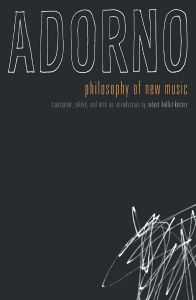
Translated, edited, and with an introduction by Robert Hullot-Kentor Intensely polemical from its first publication in 1949, every aspect of Philosophy of New Music was met with extreme reactions. Marking a turning point in Theodor Adorno's musicological philosophy, this book became highly regarded and widely read among musicians, scholars, and philosophers. In this new translation, Philosophy of New Music emerges as an indispensable key to Adorno's illustrious and influential oeuvre.
A manifesto on how criticism could actively participate in and clarify artistic concerns, immanently complicating solidarity between theory and practice.
Platypus Review
In 1949, Theodor W. Adorno’s Philosophy of New Music was published, coinciding with the prominent philosopher’s return to a devastated Europe after his exile in the United States. Intensely polemical from its first publication, every aspect of this work was met with extreme reactions, from stark dismissal to outrage. Even Arnold Schoenberg reviled it.
Despite the controversy, Philosophy of New Music became highly regarded and widely read among musicians, scholars, and social philosophers. Marking a major turning point in his musicological philosophy, Adorno located a critique of musical reproduction as internal to composition, rather than a matter of musical performance. Consisting of two distinct essays, “Schoenberg and Progress” and “Stravinsky and Reaction,” Philosophy of New Music poses the musical extremes in which Adorno perceived the struggle for the cultural future of Europe: between human emancipation and barbarism, between the compositional techniques and achievements of Schoenberg and Stravinsky.
In this translation, which is accompanied by an extensive introduction by distinguished translator Robert Hullot-Kentor, Philosophy of New Music emerges as an essential guide to the whole of Adorno's oeuvre.
A manifesto on how criticism could actively participate in and clarify artistic concerns, immanently complicating solidarity between theory and practice.
Platypus Review
A surprisingly accessible entry point into understanding Adorno the aesthete. Through a well-crafted and detailed introduction, Hullot-Kentor allows us to glimpse Adorno at the time of this writing—both enamored of and bothered by the works of Schoenberg, repulsed by American culture, not yet hardened into the diamond point of negative dialectics.
PopMatters
With Hullot-Kentor's masterful translation, readers can now more accurately debate the place of Philosophy of New Music within today's cultural situation.
Cultural Critique
Related Publications



 French Theory
How Foucault, Derrida, Deleuze, & Co. Transformed the Intellectual Life of the United States
French Theory
How Foucault, Derrida, Deleuze, & Co. Transformed the Intellectual Life of the United States