Nakagami, Japan
Buraku and the Writing of Ethnicity
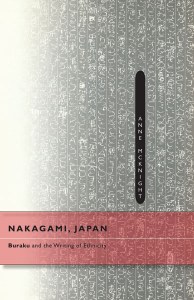
Anne McKnight shows how Nakagami Kenji’s exploration of buraku writing led to a unique blend of fiction and ethnography—and a reimagining of modern Japanese literature. McKnight develops a parallax view of Nakagami's achievement, allowing us to see the writer much as he saw himself, as a writer whose accomplishments traversed both buraku literary arts and high literary culture in Japan.
Anne McKnight's proposal that we understand Nakagami's writings in terms of a 'parallax vision' immediately resonates in the mind of anyone familiar with his works: it is an approach that finally allows Nakagami to be Nakagami. We know that we need to get outside the framework of national literary studies, but that is a task easier said than done. McKnight goes a good deal of the way toward showing us what is to be done now in the study of both Japanese literature and minority cultures.
Michael K. Bourdaghs, University of Chicago
How do you write yourself into a literature that doesn't know you exist? This was the conundrum confronted by Nakagami Kenji (1946–1992), who counted himself among the buraku-min, Japan’s largest minority. His answer brought the histories and rhetorical traditions of buraku writing into the high culture of Japanese literature for the first time and helped establish him as the most canonical writer born in postwar Japan.
In Nakagami, Japan, Anne McKnight shows how the writer’s exploration of buraku led to a unique blend of fiction and ethnography—which amounted to nothing less than a reimagining of modern Japanese literature. McKnight develops a parallax view of Nakagami’s achievement, allowing us to see him much as he saw himself, as a writer whose accomplishments traversed both buraku literary arts and high literary culture in Japan.
As she considers the ways in which Nakagami and other twentieth-century writers used ethnography to shape Japanese literature, McKnight reveals how ideas about language also imagined a transfigured relation to mainstream culture and politics. Her analysis of the resulting “rhetorical activism” lays bare Nakagami’s unique blending of literature and ethnography within the context of twentieth-century ideas about race, ethnicity, and citizenship—in Japan, but also on an international scale.
Anne McKnight's proposal that we understand Nakagami's writings in terms of a 'parallax vision' immediately resonates in the mind of anyone familiar with his works: it is an approach that finally allows Nakagami to be Nakagami. We know that we need to get outside the framework of national literary studies, but that is a task easier said than done. McKnight goes a good deal of the way toward showing us what is to be done now in the study of both Japanese literature and minority cultures.
Michael K. Bourdaghs, University of Chicago
The more one reads this work, the more one realizes that there may actually be a solution to the problem of “gap theory” and binary systems. Although McKnight did not push her analysis so far, her approach may prove an excellent antidote to the postcolonial chestnut of “closure.” In other words, one does not need to be “outside the text” in order to become the writing subject. Using parallax, the writer can be at one and the same time subject and object, as well as whatever it is that lies between. This is a very exciting way to push the boundaries of literary studies, and one would hope that this book finds its way onto the shelves of specialists in other languages, where it would surely resonate with other studies of minority and national literature.
Monumenta Nipponica
Acknowledgments
Introduction: I Is an Other
1. An Archive of Activism
2. Confession and the Crisis of Buraku Writing in the 1970s
3. Constituents of National Literature
4. Inaudible Man
5. The 38th Parallax: Nakagami in/and Korea
6. Subculture and the South Conclusion
Notes
Index