Little White Houses
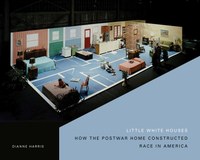
How the Postwar Home Constructed Race in America
LISTEN: DIANNE HARRIS iN CONVERSATION WITH MABEL O. WILSON
How the ordinary American house contributed to definitions of middle-class whiteness and an exclusionary housing market in the postwar era
Dianne Harris examines how postwar media representations associated the ordinary single-family house with middle-class whites to the exclusion of others, creating a powerful and invidious cultural iconography that continues to resonate today. Richly detailed and illustrated, Little White Houses adds a new dimension to our understanding of race in America and the inequalities that persist in the U.S. housing market.
"In this fascinating probe of the familiar suburban tract homes of the post–World War II era, Dianne Harris powerfully conveys how race and class were inscribed on the new metropolitan landscape. White middle-class America was born and raised in suburbia, a legacy we still live with today."—Lizabeth Cohen, author of A Consumers’ Republic: The Politics of Mass Consumption in Postwar America

A rare exploration of the racial and class politics of architecture, Little White Houses examines how postwar media representations associated the ordinary single-family house with middle-class whites to the exclusion of others, creating a powerful and invidious cultural iconography that continues to resonate today. Drawing from popular and trade magazines, floor plans and architectural drawings, television programs, advertisements, and beyond, Dianne Harris shows how the depiction of houses and their interiors, furnishings, and landscapes shaped and reinforced the ways in which Americans perceived white, middle-class identities and helped support a housing market already defined by racial segregation and deep economic inequalities.
After describing the ordinary postwar house and its orderly, prescribed layout, Harris analyzes how cultural iconography associated these houses with middle-class whites and an ideal of white domesticity. She traces how homeowners were urged to buy specific kinds of furniture and other domestic objects and how the appropriate storage and display of these possessions was linked to race and class by designers, tastemakers, and publishers. Harris also investigates lawns, fences, indoor–outdoor spaces, and other aspects of the postwar home and considers their contribution to the assumption that the rightful owners of ordinary houses were white.
Richly detailed and heavily illustrated, Little White Houses adds a new dimension to our understanding of race in America and the inequalities that persist in the U.S. housing market.
In this fascinating probe of the familiar suburban tract homes of the post–World War II era, Dianne Harris powerfully conveys how race and class were inscribed on the new metropolitan landscape. White middle-class America was born and raised in suburbia, a legacy we still live with today.
Lizabeth Cohen, author of A Consumers’ Republic: The Politics of Mass Consumption in Postwar America
Impressively interdisciplinary and marvelously attentive to telling details, intimate lives, and social structures, Dianne Harris joins Dolores Hayden, Gwendolyn Wright, and others in making the architecture and landscape of everyday lives illuminate the workings of an entire historical period. Little White Houses is a blockbuster contribution to the critical study of whiteness and to the history of the United States after World War II.
David Roediger, author of How Race Survived U.S. History: From Settlement and Slavery to the Obama Phenomenon
Harris has contributed a major shift in perspective toward new and important ways to understand the history of postwar housing in the United States.
Antipode
Little White Houses establishes a clearly articulated framework which future studies may be informed..., general readers and academics alike should take great interest in her provocative and groundbreaking book.
Art Libraries Society of North America (ARLiS/NA)
Highly recommended.
Choice
Harris’ book should motivate scholarly discussions and discourse for continued work toward creation of a more civil American society.
Journal of Family & Consumer Sciences
[Harris’s] nuanced conception of the relationship between perceptions of racial identity, the federal systems of real estate financing, and the ways in which individual cultural choices defined the physical spaces associated with he single-family home is thoughtful and well-executed. However, the crucial correction to architectural histories that overlook the myriad roles race played in assumptions about design consistently marks the fundamental excellence of the text.
American Historical Review
[Harris] powerfully conveys the idea that socially conditioned personal, family, and even national identities are fashioned as much from material and spatial configurations of the home as from explicit political and cultural beliefs.
Journal of Architectural Education
Little White Houses is both lots of fun and incredibly valuable.
American Studies
Little White Houses offers an important contribution to the fields of suburban studies and whiteness studies, as well as to architectural history as a whole, providing a fresh look at the racial and classed dimensions of space and its representation and promotion during the postwar era.
Journal of American Studies
Harris’s ingenuity in teasing out radical modern innovation, rapid historical change, and insidious ideological operations from the most mundane and familiar objects and arrangements is fascinating.
Traditional Dwellings & Settlements Review
Few scholars have so effectively drawn attention to the most unremarkable aspects of the built environment. Harris has produced a book that will be sure to engage readers and influence scholarship for many years to come.
Buildings & Landscapes
An excellent look into the crucial role the spaces of the home played in American identity formation and, more specifically, how those identities were strongly shaped by the narrow vision of home life in the postwar world.
H-Net Reviews
Contents
Preface
Introduction: Race and the Residential Sphere
1. The Ordinary Postwar House
2. Magazine Lessons: Publishing the Lexicon of White Domesticity
3. Rendered Whiteness: Architectural Drawings and Graphics
4. Private Worlds: The Spatial Contours of Exclusion and Privilege
5. Household Goods: Purchasing and Consuming Identity
6. Built-ins and Closets: Status, Storage, and Display
7. The Home Show: Televising the Postwar House
8. Designing the Yard: Gardens, Property, and Landscape
Epilogue
Acknowledgments
Notes
Index
UMP blog - Housing and race: More than meets the eye
At a prominent intersection in my city, a billboard presents the face of a white woman, her furrowed brow and sad eyes conveying a state of distress. A red-lettered caption to the right of her portrait reads “I don’t want to lose my house.” Paid for by Making Home Affordable, a program of the Departments of the Treasury and Housing and Urban Development, the sign presents a poignant reminder that the U.S. housing crisis that began in 2008 is not behind us.