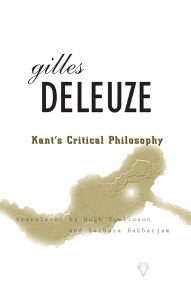
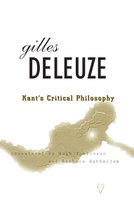
Kant’s Critical Philosophy
The Doctrine of the Faculties
“Deleuze demonstrates a remarkable sensitivity to the intentions and achievements of Kant's critical project. The result is . . . an intelligent and thoughtful reading of, and introduction to, the fundamental project of Kantian thought.” International Studies in Philosophy
“Deleuze demonstrates a remarkable sensitivity to the intentions and achievements of Kant's critical project. The result is . . . an intelligent and thoughtful reading of, and introduction to, the fundamental project of Kantian thought.” International Studies in Philosophy
Kant's Critical Philosophy
“Deleuze demonstrates a remarkable sensitivity to the intentions and achievements of Kant's critical project. The result is . . . an intelligent and thoughtful reading of, and introduction to, the fundamental project of Kantian thought.” International Studies in Philosophy
“This little book is a ‘jewel,’ a superb, and truly enlightening, presentation of the whole of Kant’s thought. . . . It is Deleuze’s intention to render transparent and readable what is most obscure, and rarely referred to in introductory works on Kant, or even in more learned works on this author-and he fully succeeds in achieving this goal.” Rodolphe Gasché, SUNY Buffalo
This concise, systematic key to Kant’s thought by noted philosopher Gilles Deleuze surveys the essential themes of all three Critiques (Critique of Pure Reason, Critique of Practical Reason, and Critique of Judgment), taking into account their interrelationships and revealing the structure of Kant’s entire critical philosophy.
Gilles Deleuze (1925-1995) was professor of philosophy at the University of Paris-VIII at Saint-Denis. Among his numerous books are Anti-Oedipus, A Thousand Plateaus, and Kafka: Toward a Minor Literature (all cowritten with Félix Guattari), as well as Foucault, The Fold: Leibniz and the Baroque, Cinema 1: The Movement-Image, and Cinema 2: The Time-Image. All of these works are available from the University of Minnesota Press.
“Deleuze demonstrates a remarkable sensitivity to the intentions and achievements of Kant's critical project. The result is . . . an intelligent and thoughtful reading of, and introduction to, the fundamental project of Kantian thought.” International Studies in Philosophy
This little book is a ‘jewel,’ a superb, and truly enlightening, presentation of the whole of Kant’s thought. . . . It is Deleuze’s intention to render transparent and readable what is most obscure, and rarely referred to in introductory works on Kant, or even in more learned works on this autho
and he fully succeeds in achieving this goal.” Rodolphe Gasché, SUNY Buffalo