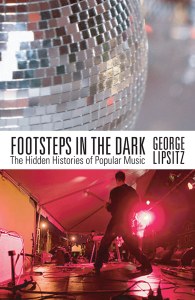
Footsteps in the Dark
The Hidden Histories of Popular Music
George Lipsitz illuminates the secret meanings of popular music, offering imaginative interpretations of a wide range of popular music genres from jazz to salsa to rock. Footsteps in the Dark puts forth an alternate history of post–cold war America and shows why in an era given to easy answers and clichéd versions of history, pop songs matter more than ever.
Footsteps in the Dark digs deep and reaches wide, revealing a treasure trove of powerful and denied knowledges about a dazzling range of popular musics and the communities of people out of which they emerge. Engrossing, accessible and sophisticated, this book puts to rest the misconception that popular music is irrelevant and disconnected from the important issues that shape society.
Tricia Rose, author of Black Noise: Rap Music and Black Culture in Contemporary America

Most pop songs are short-lived. They appear suddenly and, if they catch on, seem to be everywhere at once before disappearing again into obscurity. Yet some songs resonate more deeply-often in ways that reflect broader historical and cultural changes.
In Footsteps in the Dark, George Lipsitz illuminates these secret meanings, offering imaginative interpretations of a wide range of popular music genres from jazz to salsa to rock. Sweeping changes that only remotely register in official narratives, Lipsitz argues, can exist in vivid relief within popular music, especially when these changes occur outside mainstream white culture. Using a wealth of revealing examples, he discusses such topics as the emergence of an African American techno music subculture in Detroit as a contradictory case of digital capitalism and the prominence of banda, merengue, and salsa music in the 1990s as an expression of changing Mexican, Dominican, and Puerto Rican nationalisms. Approaching race and popular music from another direction, he analyzes the Ken Burns PBS series Jazz as a largely uncritical celebration of American nationalism that obscures the civil rights era’s challenge to racial inequality, and he takes on the infamous campaigns to censor hip-hop and the radical black voice in the early 1990s.
Teeming with astute observations and brilliant insights about race and racism, deindustrialization, and urban renewal and their connections to music, Footsteps in the Dark puts forth an alternate history of post–cold war America and shows why in an era given to easy answers and clichéd versions of history, pop songs matter more than ever.
Footsteps in the Dark digs deep and reaches wide, revealing a treasure trove of powerful and denied knowledges about a dazzling range of popular musics and the communities of people out of which they emerge. Engrossing, accessible and sophisticated, this book puts to rest the misconception that popular music is irrelevant and disconnected from the important issues that shape society.
Tricia Rose, author of Black Noise: Rap Music and Black Culture in Contemporary America
Footsteps in the Dark is a virtuosic and inspiring contribution to popular music studies and cultural studies more broadly.
Rob Walser, editor of Keeping Time: Readings in Jazz History
Lipsitz’s approach is sophisticate; he understands well the commercial nature of his subject. Footsteps in the Dark should be indispensable reading not only for popular culture and music scholars, but for all historians interested in understanding social change in a modern setting. Music, indeed, does matter.
Journal of American History
Footsteps in the Dark is George Lipsitz’s most ambitious book to date exclusively on music, and perhaps his most passionate, candid, and unflinching period. The heart of Lipsitz’s cumulative message, and that message—about deepening our understanding of historical processes through the study of popular music, about the relationship between historical knowledge and social justice, about how transitional realities produce ‘new cultural forms speaking to new social identities’ with the potential for new social relations—is timely and of critical importance.
Current Musicology
Footsteps in the Dark is groundbreaking in attempting to shatter conventional spatial and temporal frameworks for popular music studies, drawing far-reaching historical connections across continents and centuries.
Ethnomusicology
Contents
Introduction: The Long Fetch of History; or, Why Music Matters
1. Pop Stars: The Hidden History of Digital Capitalism
2. Crossing Over: The Hidden History of Diaspora
3. Banda: The Hidden History of Greater Mexico
4. Jazz: The Hidden History of Nationalist Multiculturalism
5. Weeds in a Vacant Lot: The Hidden History of Urban Renewal
6. Merengue: The Hidden History of Dominican Migration
7. The Hip Hop Hearings: The Hidden History of Deindustrialization
8. Masquerades and Mixtures: The Hidden History of Passing
9. Salsa: The Hidden History of Colonialism
10. Techno: The Hidden History of Automation
Epilogue: Long Waves after 9/11
Acknowledgments
Notes
Index