Fighting for the Future of Food
Activists versus Agribusiness in the Struggle over Biotechnology
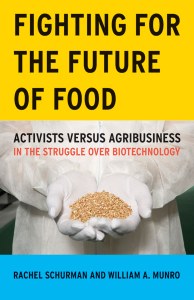
Fighting for the Future of Food tells the story of how a group of social activists, working together across tables, continents, and the Internet, took on the biotech industry and achieved stunning success. Rachel Schurman and William A. Munro address society’s understanding and trust (or mistrust) of technological innovation and the complexities of the global agricultural system providing our food.
Rachel Schurman and William A. Munro take a fresh and carefully balanced look at the social movement spawned by this technology. Anyone who wants to understand why groups across the globe oppose genetically modified foods will find this book revelatory.
Marion Nestle, author of Food Politics and Safe Food
When scientists working in the agricultural biotechnology industry first altered the genetic material of one organism by introducing genes from an entirely different organism, the reaction was generally enthusiastic. To many, these genetically modified organisms (GMOs) promised to solve the challenges faced by farmers and to relieve world hunger. Yet within a decade, this “gene revolution” had abruptly stalled. Widespread protests against the potential dangers of “Frankenfoods” and the patenting of seed supplies in the developing world forced the industry to change course. As a result, in the late 1990s, some of the world’s largest firms reduced their investment in the agricultural sector, narrowed their focus to a few select crops, or sold off their agricultural divisions altogether.
Fighting for the Future of Food tells the story of how a small group of social activists, working together across tables, continents, and the Internet, took on the biotech industry and achieved stunning success. Rachel Schurman and William A. Munro detail how the anti-biotech movement managed to alter public perceptions about GMOs and close markets to such products. Drawing strength from an alternative worldview that sustained its members’ sense of urgency and commitment, the anti-GMO movement exploited political opportunities created by the organization and culture of the biotechnology industry itself.
Fighting for the Future of Food ultimately addresses society’s understanding and trust (or mistrust) of technological innovation and the complexities of the global agricultural system that provides our food.
Awards
2011 Lynton Caldwell Prize for Best Book in Environmental Politics
Rachel Schurman and William A. Munro take a fresh and carefully balanced look at the social movement spawned by this technology. Anyone who wants to understand why groups across the globe oppose genetically modified foods will find this book revelatory.
Marion Nestle, author of Food Politics and Safe Food
Fighting for the Future of Food provides a new and compelling account of the contemporary struggles over agricultural biotechnology. This superb depiction of the cultural and social lifeworlds of both the agro-industries and of the activists, simultaneously reveals the hubris and market ambition of agro-genetic engineering and of the formation of an oppositional ideology. A brave and unflinching account of the world of contemporary agribusiness and its opponents.
Michael Watts, University of California, Berkeley
Compelling and eminently readable account.
Global Environmental Politics
This volume provides an excellent account of many of the complex twists and turns of the GMO debates in the United States, Europe, and Africa over the last thirty years.
Contemporary Sociology
With Fighting for the Future of Food, Schurman and Munro deliver an empirically and theoretically revealing, politically dedicated and very readable account of one of the biggest protest movements of today.
Social Movement Studies
All scholars will admire the breathtaking methodology of the book, a fine example of conjunctural analysis woven together by a coherent argument and clear architecture. . . . It must be read.
Economic Geography
Schurman and Munro rigorously and unflinchingly explored the social and cultural lifeworlds of the proponents of the biotechnology industry and the opposing social activists who reject the industry’s approach to genetic engineering.
Journal of Family & Consumer Sciences
A useful and well-researched book.
Springer Science+Business Media B.V.
Schurman and Munro have provided a comprehensive, readable, and theoretically informed overview of the contested development and commercialization of transgenic organisms.
Agriculture and Human Values
A noteworthy contribution to the growing food studies literature, to the established literature on the global controversies surrounding food biotechnology and to the more established social movements literature.
Oxford Journals- Social Forces
A well-written history of the struggles of activists both for and against the development of genetically modified organisms (GMOs) in relation to food production.
Science as Culture
Fighting for the Future of Food provides an excellent account of the political struggles around biotechnology in an age of vast and fast-paced global circulations of technology, capital markets, risk, and social movements. Methodologically, Rachel Schurman and William Munro combine carefully crafted analyses of the lifeworlds of both the biotechnology industry and social movement actors. The result is not only a superbly insightful book on the contentious politics around biotechnological agriculture, but an exemplary contribution to the growing literature on social movements.
American Journal of Sociology
Schurman and Munro form a powerful duo as a sociologist and political scientist. Together they successfully combined knowledge from their respective fields to offer a first-rate insight into the inner workings of the two primary parties involved in this debate.
Agribusiness
Contents
Introduction: The Contending Worlds of Biotechnology
1. Precursors to Protest
2. Creating an Industry Actor
3. Forging a Global Movement
4. The Struggle over Biotechnology in Western Europe
5. Creating Controversy in the United States
6. Biotech Battles and Agricultural Development in Africa
Conclusion: A Different Future for Biotechnology?
Acknowledgments
Appendix: Data Sources
Notes
Bibliography
Index
UMP blog: Activism and the new agricultural biotechnologies
9/29/2011
Some people have asked whether our book is anti-biotech. In our view, that is not really the right question. The arguments over agricultural biotechnology are both deeply polarized and deeply polarizing (this is a key theme in our analysis). To characterize the book in terms of one or another broad label, such as ‘anti-biotech’ or ‘pro-biotech,’ is to adopt and to reinforce such polarization — it places our analysis in one of two possible categories. Yet, as we believe our book illustrates, such broad labeling obfuscates more than it illuminates. Read more ...