DisForming the American Canon
African-Arabic Slave Narratives and the Vernacular
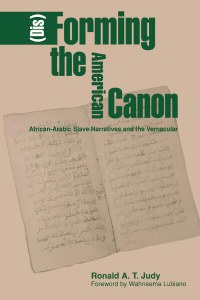
Judy offers an alternative interpretation of literacy that challenges traditional Enlightenment discourse’s claim that literacy and reason are the privileged properties of Western culture. Judy argues, on the basis of his readings of autobiographical African-American Arabic slave narratives, that through the production of the Arabic text, the African slave already had all the elements that the West attributes to “reason” before his original introduction to Western culture-a literacy that already mediated between Africa and Europe.
“Has the potential to completely remake American Studies while serving as an excellent example of what theoretical informed criticism should be.” --Paul Bové
. . . is an ambitious and rich work that takes up questions of tradition and modernity, cultural formation and theories of language and thought.
American Literature
“Has the potential to completely remake American Studies while serving as an excellent example of what theoretical informed criticism should be.”
Paul Bové
University of Pittsburgh
To date, few critical studies have examined the African-American slave narratives that were written in Arabic, and none of these has seized the occasion to reconsider the problems of translation and canon formation, the relationship between literacy and reason, and the relation of Western Enlightenment reason to Arabic texts.
In (Dis)Forming the American Canon, Ronald A. T. Judy offers an alternative interpretation of literacy that challenges that claim of traditional Enlightenment discourse that literacy and reason are the privileged properties of Western culture. On the basis of his readings of autobiographical African-Arabic American slave narratives, Judy argues that through the production of the Arabic text, the African slave already had the necessary element that the West attributes to “reason” before his original introduction to Western culture: a literacy that mediated between Africa and Europe.
Paying careful attention to the problems of translation and canon formation, (Dis)Forming the American Canon demonstrates how cultural values, the humanities, and Western figures of reason must be transformed, and in particular how national literary traditions must ultimately be reconstituted and globalized. In addition, (Dis)Forming the American Canon includes the first published translation of the longest Arabic-language slave narrative known to exist in North America, the purportedly autobiographical nineteenth-century Arabic slave narrative known as Ben Ali’s Diary.
. . . is an ambitious and rich work that takes up questions of tradition and modernity, cultural formation and theories of language and thought.
American Literature