Constitutional Modernism
Architecture and Civil Society in Cuba, 1933–1959
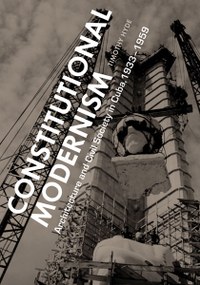
Constitutional Modernism explores architecture, planning, and law as cultural forces, analyzing the complex entanglements between these disciplines in the Cuban Republic. Timothy Hyde reveals how architects joined with other professionals and intellectuals in efforts to establish a stable civil society, from the promulgation of a new Cuban Constitution in 1940 up until the Cuban Revolution.
This is a major book on Cuba. It is the best history of modern Havana ever written, unlikely to be surpassed. Timothy Hyde is a thorough, scrupulous historian with a sophisticated grasp of architectural history and theory, as well as of the political and artistic history of Cuba. He chronicles in dramatic detail the vigorous debates around the question of cubanidad that led to the proclamation of the 1940 constitution, and to the formulation and execution of plans for the development of Havana: its plazas, boulevards, public buildings, and monuments. These deliberations, which included prominent intellectuals such as Fernando Ortiz and Jorge Mañach, came to an end with the advent of Castro’s regime.
Roberto González Echevarría, Yale University
How does architecture make its appearance in civil society? Constitutional Modernism pursues this challenging question by exploring architecture, planning, and law as cultural forces. Analyzing the complex entanglements between these disciplines in the Cuban Republic, Timothy Hyde reveals how architects joined with other professionals and intellectuals in efforts to establish a stable civil society, from the promulgation of a new Cuban Constitution in 1940 up until the Cuban Revolution.
By arguing that constitutionalism was elaborated through architectural principles and practices as well as legal ones, Hyde offers a new view of architectural modernism as a political and social instrument. He contends that constitutionalism produced a decisive confluence of law and architecture, a means for planning the future of Cuba. The importance of architecture in this process is laid bare by Hyde’s thorough scrutiny of a variety of textual, graphical, and physical artifacts. He examines constitutional articles, exhibitions, interviews, master plans, monuments, and other primary materials as acts of design.
Read from the perspective of architectural history, Constitutional Modernism demonstrates how the modernist concepts that developed as an international discourse before the Second World War evolved through interactions with other disciplines into a civil urbanism in Cuba. And read from the perspective of Cuban history, the book explains how not only material products such as buildings and monuments but also the immaterial methods of architecture as a cultural practice produced ideas that had consequential effects on the political circumstances of the nation.
This is a major book on Cuba. It is the best history of modern Havana ever written, unlikely to be surpassed. Timothy Hyde is a thorough, scrupulous historian with a sophisticated grasp of architectural history and theory, as well as of the political and artistic history of Cuba. He chronicles in dramatic detail the vigorous debates around the question of cubanidad that led to the proclamation of the 1940 constitution, and to the formulation and execution of plans for the development of Havana: its plazas, boulevards, public buildings, and monuments. These deliberations, which included prominent intellectuals such as Fernando Ortiz and Jorge Mañach, came to an end with the advent of Castro’s regime.
Roberto González Echevarría, Yale University
Constitutional Modernism is both a work of great length and great scholarship. It is well written and makes an important contribution to the study of modernism in a peripheral country with a long architectural tradition.
Journal of Architectural Education
Enhanced by a careful selection and iconology of images—evident from the book’s very opening—Hyde’s erudite discourse about Cuba’s constitutional modernism, both in architecture and urbanism, stands out not only as a bibliographic contribution to the emergence of those professions in the island’s political and institutional framework, but also helps to understand such processes in other Latin American countries.
Planning Perspectives
Constitutional Modernism succeeds in reading the consequential effects of architecture in the political circumstances of the Cuban nation in the early twentieth century. It contributes to a growing body of scholarship dealing with variations on architectural modernism in ex-colonial cities and countries, such as the work of Tom Avermaete, Serhat Karakayali, and Marion von Osten on Algeria and Morocco and that of Swati Chattopadhyay on Calcutta. Moreover, it opens the door for future studies looking more deeply at the lived experiences of the Cuban citizens during that time period. Given this thorough foundation in the study of architecture as a form of civic possibility, future scholars can now flesh out the social dynamics of these spaces through studies of the intricacies of Cuban culture, ranging from Afro-Cuban religious customs to the everyday life of the working-class poor.
Journal of the Society of Architectural Historians
Timothy Hyde has compiled a tour de force in his examination of architectural and urban design practices that were socially construed when Cuban civil society and statesmen aimed to redefine the nation’s identity.
New West Indian Guide
There is plenty of food for thought here.
Hispanic American Historical Review
Contents
Abbreviations
Introduction: Constitutionalism and Civil Society
I. Constitution
1. The Idealized Republic: The Constitution of 1940
2. Better Cities, Better Citizens: The Political Function of Planning
3. A Perfect Structuring: Representing the Nation as Plan and Purpose
II. City
4. Public Works: Constructing the Urban Spaces of Civil Society
5. Master Plans: The Retrospective Order of the Plan Piloto de la Habana
6. Historic Districts: The Regulation of the Past in Habana Vieja
III. Monument
7. The Experience of Civic Conscience: Designs for the Monumento a Martí
8. The Prospect of cubanidad: Figural Forms and the Palacio de las Palmas
Epilogue: Futures of Constitutional Modernism
Acknowledgments
Notes
Bibliography
Index
Abbreviations