Citizens’ Media against Armed Conflict
Disrupting Violence in Colombia
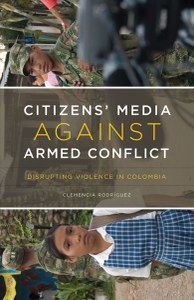
For two years, Clemencia Rodríguez did fieldwork in regions of Colombia where leftist guerillas, right-wing paramilitary groups, the army, and drug traffickers made their presence felt in the lives of unarmed civilians. Here, Rodríguez tells the story of how these civilians use community radio, television, video, digital photography, and the Internet to shield their communities from armed violence’s negative impacts.
Clemencia Rodríguez has given us an astonishing ethnographic study of ‘citizens’ media’ in Colombia. Remarkably, and with great insight into what uses of such ‘small media’ can accomplish, she offers readers a glimmer of hope in a stark war-torn social landscape, as well as a welcome and original intervention into contemporary theorizations of media worlds in circumstances of violence.
Faye Ginsburg, New York University
For two years, Clemencia Rodríguez did fieldwork in regions of Colombia where leftist guerillas, right-wing paramilitary groups, the army, and drug traffickers made their presence felt in the lives of unarmed civilians. Here, Rodríguez tells the story of the ways in which people living in the shadow of these armed intruders use community radio, television, video, digital photography, and the Internet to shield their communities from armed violence’s negative impacts.
Citizens’ media are most effective, Rodríguez posits, when they understand communication as performance rather than simply as persuasion or the transmission of information. Grassroots media that are deeply embedded in the communities they serve and responsive to local needs strengthen the ability of community members to productively react to violent incursions. Rodríguez demonstrates how citizens’ media privilege aspects of community life not hijacked by violence, providing people with the tools and the platform to forge lives for themselves and their families that are not entirely colonized by armed conflict and its effects.
Ultimately, Rodríguez shows that unarmed civilian communities that have been cornered by armed conflict can use community media to repair torn social fabrics, reconstruct eroded bonds, reclaim public spaces, resolve conflict, and sow the seeds of peace and stability.
Clemencia Rodríguez has given us an astonishing ethnographic study of ‘citizens’ media’ in Colombia. Remarkably, and with great insight into what uses of such ‘small media’ can accomplish, she offers readers a glimmer of hope in a stark war-torn social landscape, as well as a welcome and original intervention into contemporary theorizations of media worlds in circumstances of violence.
Faye Ginsburg, New York University
Rodríguez combines vivid ethnography with trenchant historical and sociological analysis in this important contribution to peace studies and media anthropology.
Choice
Contents
Life at the Crossfire: An Introduction to Colombia's Violence and Its Context
1. Drugs, Violence, and the Media of the People in the Colombian Amazon
2. Nation-building, One Voice at a Time: Citizens’ Communication in Montes de María
3. Radio, Resistance, and War in Madgalena Medio
4. Media Pioneers Respond to Armed Conflict
5. The Doing Is Everything! Toward a Theory of Citizens' Media in Contexts of War
Acknowledgments
Acronyms
Notes
Bibliography
Indigenous and Citizens' Media References
Index
Related Publications
 The Art of Protest
Culture and Activism from the Civil Rights Movement to the Present, Second Edition
The Art of Protest
Culture and Activism from the Civil Rights Movement to the Present, Second Edition