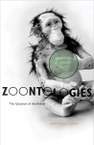
CIFERAE
A Bestiary in Five Fingers
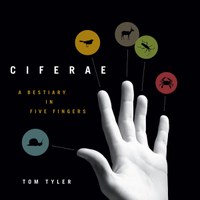
A bold investigation into the philosophical and intellectual parameters of the question of the animal, Tom Tyler’s book features “wild animals” (ferae)—both real and imaginary—who appear in the works of philosophy as mere ciferae, or ciphers. Tyler ultimately challenges claims of human distinctiveness and superiority, which are so often represented by the supposedly unique and perfect human hand.
Tom Tyler’s reinvention of the bestiary is a remarkable achievement, and Tyler emerges as an engaging storyteller. The book’s teeming pages are full of improbable pleasures, pictorial and philosophical. Presented with modesty and wit, the result is an audacious account of what it is not to be human. This is a beautifully written book of exceptional imaginative range and it amounts to nothing less than a poetics of the posthuman.
Steve Baker, author of The Postmodern Animal
The Greek philosopher Protagoras, in the opening words of his lost book Truth, famously asserted, “Man is the measure of all things.” This contention—that humanity cannot know the world except by means of human aptitudes and abilities—has endured through the centuries in the work of diverse writers. In this bold and creative new investigation into the philosophical and intellectual parameters of the question of the animal, Tom Tyler explores a curious fact: in arguing or assuming that knowledge is characteristically human, thinkers have time and again employed animals as examples, metaphors, and fables. From Heidegger’s lizard and Popper’s bees to Saussure’s ox and Freud’s wolves, Tyler points out, “we find a multitude of brutes and beasts crowding into the texts to which they are supposedly unwelcome.”
Inspired by the medieval bestiaries, Tyler’s book features an assortment of “wild animals” (ferae)—both real and imaginary—who appear in the works of philosophy as mere ciferae, or ciphers; each is there deployed as a placeholder, of no importance or worth in their own right. Examining the work of such figures as Bataille, Moore, Nietzsche, Kant, Whorf, Darwin, and Derrida, among others, Tyler identifies four ways in which these animals have been used and abused: as interchangeable ciphers; as instances of generalized animality; as anthropomorphic caricatures; and as repetitive stereotypes. Looking closer, however, he finds that these unruly beasts persistently and mischievously question the humanist assumptions of their would-be employers.
Tyler ultimately challenges claims of human distinctiveness and superiority, which are so often represented by the supposedly unique and perfect human hand. Contrary to these claims, he contends that the hand is, in fact, a primitive organ, and one shared by many different creatures, thereby undercutting one of the foundations of anthropocentricism and opening up the possibility of nonhuman, or more-than-human, knowledge.
Tom Tyler’s reinvention of the bestiary is a remarkable achievement, and Tyler emerges as an engaging storyteller. The book’s teeming pages are full of improbable pleasures, pictorial and philosophical. Presented with modesty and wit, the result is an audacious account of what it is not to be human. This is a beautifully written book of exceptional imaginative range and it amounts to nothing less than a poetics of the posthuman.
Steve Baker, author of The Postmodern Animal
CIFERAE is a remarkable accomplishment. Tyler provides the most subtle and thorough analysis of anthropocentrism I have encountered; and his critical reworking of the relationship between animals and philosophy allows for an extraordinarily rich understanding of more-than-human subjectivities.
Matthew Calarco, California State University, Fullerton
CIFERAE engages and pushes forward the theoretical foundation of human-animal studies. Tyler aptly develops a critique that encourages the recognition of a perspective that decenters human experience as the primary mode through which knowledge is produced. This work also has pragmatic implications, as it clears a path to understanding people’s subjective experiences as ‘more than human.’
Society and Animals
Delivers tremendous insight into philosophy’s indefensible anthropocentrism, concluding that pragmatic knowledge (and its refusal of a “God’s eye view”) is most promising.
CHOICE
CIFERAE is a tour de force through occidental philosophy, aiming at leading humankind from anthropocentrism into biocoenosis, without dispensing with its exceptionality . . . Tyler's approach, which consists of countering anthropocentrism through encounters with epistemological animals, succeeds in deploying the dialectic between thinking as praxis, and thinking as reflection on praxis. Thus, by reconstructing anthropocentrism he manages to expose its idealistic core.
Tierstudien
Sizable but thoroughly convincing. . . [CIFERAE] is a thoroughly enjoyable experiment in literary analysis and creation, a very original attempt at weaving very different themes — epistemology, animals, and hands — into a broad discussion that constantly plays with its own elements.
Journal for Critical Animal Studies
Tom Tyler’s trenchant study of anthropocentric and philosophical discourse, part of Cary Wolfe’s impressive “Posthumanities” series, is an important addition to the literature on human knowledge and epistemology, approached here through philosophy’s unsteady preoccupation with non-human animals. The book itself is something of a marvel—modeled on the medieval bestiary, it comes complete with ornamental capitals, eclectic marginal glosses, and around the border of the pages an illustrated menagerie of animal “indices”—many drawn from these earlier bestiaries.
Antennae
This book is an experience.
Environmental Values
For scholars in science studies and animals studies, CIFERAE offers a thought-provoking and entertaining opening onto a question of central importance: whether and how our membership in the human species, or in any other species, determines what we can know.
Configurations
Tom Tyler’s CIFERAE: A Bestiary in Five Fingers is a playful philosophy with a serious purpose. This is a cogently argued and beautifully produced (and illustrated) argument for why the persistent invocation of animals in philosophy is significant, and for why animal knowing (as Nietzsche recognized) drives a cart and horses through anthropocentricism.
New Formations
The book is not merely an astute jeu d’esprit around our ways to count and account animals. It also carefully probes the ostensible anthropocentricism of three dominant epistemological paradigms in Western thought: realism, relativism, and pragmatism.
Humanimalia
There is a lot going on in this book. Not only does the volume contain thought-provoking images—sketches, etchings, photographs—but extensive footnotes containing interesting facts and observations feature on every page, all of which capture the imagination, and provide context for the philosophical discussion.
Animal Studies Journal
For all that a further installment proves a beguiling prospect, it is perhaps CIFERAE’s greatest accolade that its singularity makes the idea of a sequel very hard to conceive.
Engaging with most if not all the usual suspects of Euro-American philosophy,
CIFERAE: A Bestiary in Five Fingers is practically indispensable to any course
on philosophy and other animals.
Journal of the Fantastic in the Arts
"Tyler's book is liberating and playful. ... The book is full of ideas and has the form of an inventive and playful encyclopaedia or bestiary - a page-turner for days when the thirst for knowledge hits you."
Ord & Bild
CIFERAE is not only intellectually stimulating but is also an artful volume replete with running marginalia of illustrations, captions, and sidebar passages. Continentalists in the European mode and pragmatists in the American style should find true treasure in Tyler’s text.
Liberazioni
Written in a lively, punning style, CIFERAE deserves to be read by anyone with an interest in responding to the challenge of thinking—and living—in a multi-species world.
Relations: Beyond Anthropocentrism
Ultimately, and this is precisely the value of Tyler’s text, pragmatic epistemology does away with the noxious productions of humanism and of all the various anthropocentric denials.
Journal for Cultural Research
Beautifully illustrated and playfully written—a timely and crucial contribution to critical animal studies scholarship.
Journal of Animal Ethics
Written in a lively, punning style, CIFERAE deserves to be read by anyone with an interest in responding to the challenge of think—and living—in a multi-species world.
Relations
Contents
Acknowledgments
Prelude
1. VALLATUS INDICIBUS ATQUE SICARIIS Surrounded by Informers and Assassins
Like Water in Water
Into Your Hand They Are Delivered
Deciphering Deciphering
Prickly Porcupines and Docile Dogs
An ABC of Animals
If a Lion Had Hands
Quia Ego Nominor Leo
Taking Animals in Hand
2. RIDETO MULTUM ET DIGITUM PORRIGITO MEDIUM Laugh Loudly and Flip Them the Bird
Two Hands Are Better Than One
The Truth about Mice and Ducks
The Philosopher and the Gnat
The Birds and the Bees
The Back of a Tiger
3. MEDICO TESTICULI ARIETINI On the Ring Finger a Ram’s Testicles
The Digestive System of the Mind
An Unknown Something
Praying to the Aliens
Nothing to Phone Home About
From Noumena to Nebula
Those Who Like to Think So
One Ring to Rule Them All
4. DIGITO MINIMO MUNDUM UNIVERSUM EXCITES With Your Little Finger You Would Awaken the Whole World
The Eyes Have It
A Tale of Three Fish
Handing On and Gathering In
Bird Brains
Getting Stuck In
5. MANUS PARVA, MAIORI ADIUTRIX, POLLEX The Thumb Is a Little Hand, Assistant to the Greater
To We or Not to We
If I Had a Hammer
The Rule of Thumb
Four Hands Good, Two Hands Bad
Report to an Academy
Coda
Notes
Bibliography
Publication History and Permissions
Index