Anime’s Media Mix
Franchising Toys and Characters in Japan
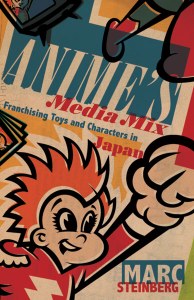
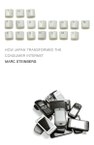
In Anime’s Media Mix, Marc Steinberg convincingly shows that anime is far more than a style of Japanese animation. Engaging with film, animation, and media studies, as well as analyses of consumer culture and theories of capitalism, Steinberg offers the first sustained study of the Japanese mode of convergence that informs global media practices to this day.
Anime’s Media Mix is a must-read for anyone interested in the transformations of contemporary media. In portraying how anime characters are emblematic of mobility and connectivity in a broader media ecology, Marc Steinberg maps a new logic of production and consumption that shapes our world today.
Ian Condry, MIT
In Anime’s Media Mix, Marc Steinberg convincingly shows that anime is far more than a style of Japanese animation. Beyond its immediate form of cartooning, anime is also a unique mode of cultural production and consumption that led to the phenomenon that is today called “media mix” in Japan and “convergence” in the West.
According to Steinberg, both anime and the media mix were ignited on January 1, 1963, when Astro Boy hit Japanese TV screens for the first time. Sponsored by a chocolate manufacturer with savvy marketing skills, Astro Boy quickly became a cultural icon in Japan. He was the poster boy (or, in his case, “sticker boy”) both for Meiji Seika’s chocolates and for what could happen when a goggle-eyed cartoon child fell into the eager clutches of creative marketers. It was only a short step, Steinberg makes clear, from Astro Boy to Pokémon and beyond.
Steinberg traces the cultural genealogy that spawned Astro Boy to the transformations of Japanese media culture that followed—and forward to the even more profound developments in global capitalism supported by the circulation of characters like Doraemon, Hello Kitty, and Suzumiya Haruhi. He details how convergence was sparked by anime, with its astoundingly broad merchandising of images and its franchising across media and commodities. He also explains, for the first time, how the rise of anime cannot be understood properly—historically, economically, and culturally—without grasping the integral role that the media mix played from the start. Engaging with film, animation, and media studies, as well as analyses of consumer culture and theories of capitalism, Steinberg offers the first sustained study of the Japanese mode of convergence that informs global media practices to this day.
Awards
2014 International Toy Research Association prize for best senior research on toys.
Anime’s Media Mix is a must-read for anyone interested in the transformations of contemporary media. In portraying how anime characters are emblematic of mobility and connectivity in a broader media ecology, Marc Steinberg maps a new logic of production and consumption that shapes our world today.
Ian Condry, MIT
Marc Steinberg opens up brave new possibilities for the study of global media cultures. Attending to the watershed years of Japan’s 1960s and the ascendance of televisual animation he details how entire commodity regimes came to circulate around the idea of the anime “character.” Original and timely, historically dense and theoretically acute, Anime’s Media Mix definitively teaches us that anime can no longer be thought outside the networks of its transmediation.
Marilyn Ivy, Columbia University
Anime’s Media Mix is invaluable for pointing out that anime characters owe much of their popularity to the advertising of their commercial tie-ins.
Animation World Network
Offers a cultural history of branding, marketing, and cross-media narrative. . . Of interest not just in cultural studies, anime studies, and Japan studies but also in marketing communications, and even business.
Choice
Engaging with film, animation, and media studies, as well as analysis of consumer culture and theories of capitalism, Steinberg offers the first sustained study of the Japanese mode of convergence that informs global media practices to this day.
LSE Review of Books
Fascinating.
Asian Studies Review
As a whole, the book is written in an engaging and lucid style. It draws on the Japanese-language scholarship on anime and marketing while making that discourse accessible for nonspecialist readers.
Journal of Japanese Studies
Historically sound and theoretically engaging, Steinberg’s book provides a critical genealogy of media mix in the context of the profound social, cultural, and economic transformations that occurred both in Japan and globally.
Journal of Asian Studies
Engaging and thoughtful.
International Journal of Communication
Contents
Introduction: Rethinking Convergence in Japan
Part I. Anime Transformations: Tetsuwan Atomu
1. Limiting Movement, Inventing Anime
2. Candies, Premiums, and Character Merchandizing: The Meiji-Atomu Marketing Campaign
3. Material Communication and the Mass Media Toy
Part II. Media Mixes and Character Consumption: Kadokawa Books
4. Media Mixes, Media Transformations
5. Character, World, Consumption
Acknowledgments
Notes
Bibliography
Index