194X
Architecture, Planning, and Consumer Culture on the American Home Front
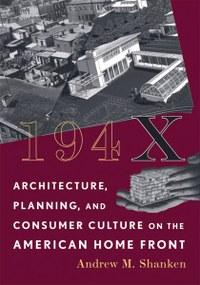
In a major study of American architecture during World War II, Andrew M. Shanken focuses on the culture of anticipation that arose in this period, as out-of-work architects turned their energies from the built to the unbuilt, redefining themselves as planners and creating original designs to excite the public about postwar architecture. Shanken recasts the wartime era as a crucible for the intermingling of modernist architecture.
Andrew Shanken offers a fascinating, compelling, and altogether convincing new lens for understanding the burst of creative and visionary design that accompanied America's engagement in the Second World War. Situating this ephemeral moment in relationship to forgotten economic mantras of the ‘mature economy’ and the end of frontier, Shanken provides a whole new framework for understanding American modernism and a bittersweet analysis of the country's brief faith in a planned future.
Barry Bergdoll
During the Second World War, American architecture was in a state of crisis. The rationing of building materials and restrictions on nonmilitary construction continued the privations that the profession had endured during the Great Depression. At the same time, the dramatic events of the 1930s and 1940s led many architects to believe that their profession—and society itself—would undergo a profound shift once the war ended, with private commissions giving way to centrally planned projects. The magazine Architectural Forum coined the term “194X” to encapsulate this wartime vision of postwar architecture and urbanism.
In a major study of American architecture during World War II, Andrew M. Shanken focuses on the culture of anticipation that arose in this period, as out-of-work architects turned their energies from the built to the unbuilt, redefining themselves as planners and creating original designs to excite the public about postwar architecture. Shanken recasts the wartime era as a crucible for the intermingling of modernist architecture and consumer culture.
Challenging the pervasive idea that corporate capitalism corrupted the idealism of modernist architecture in the postwar era, 194X shows instead that architecture’s wartime partnership with corporate America was founded on shared anxieties and ideals. Business and architecture were brought together in innovative ways, as shown by Shanken’s persuasive reading of magazine advertisements for Revere Copper and Brass, U.S. Gypsum, General Electric, and other companies that prominently featured the work of leading progressive architects, including Louis I. Kahn, Eero Saarinen, and Walter Gropius.
Although the unexpected prosperity of the postwar era made the architecture of 194X obsolete before it could be built and led to its exclusion from the story of twentieth-century American architecture, Shanken makes clear that its anticipatory rhetoric and designs played a crucial role in the widespread acceptance of modernist architecture.
Andrew Shanken offers a fascinating, compelling, and altogether convincing new lens for understanding the burst of creative and visionary design that accompanied America's engagement in the Second World War. Situating this ephemeral moment in relationship to forgotten economic mantras of the ‘mature economy’ and the end of frontier, Shanken provides a whole new framework for understanding American modernism and a bittersweet analysis of the country's brief faith in a planned future.
Barry Bergdoll
194X brilliantly lights up that most obscure of subjects, the hypothetical architecture of the war years—a visionary body of ideas, forms, and images—which though unbuilt was every bit as influential as the fantasy architecture of Piranesi. By making resourceful use of oral testimony as that period recedes from living memory, Shanken demonstrates the historical imagination at its best. In every respect, this is an original and splendidly written contribution by one of the field’s most promising young scholars.
Michael J. Lewis, author of American Art and Architecture
Shanken's research is thorough, his prose eloquent, and his argument convincing.
Choice
In revealing the story of planners, architects, and their roles in shaping public opinion toward collective action during the war years, he usefully articulates an often overlooked history and indicates some of its meaning for the challenges and dynamics that the disciplines face today.
Journal of the American Planning Association
Shanken has composed a highly accessible book that analyzes a moment where hope for the future rose in the face of wartime conditions.
Enterprise and Society
Andrew M. Shanken’s intriguing, beautifully illustrated monograph explores the anticipation with which Americans, while in the midst of total war, planned for a postwar building boom.
American Historical Review
Andrew M. Shanken contributes an untold history of architecture and urban planning in this cogent and well-illustrated book about the culture of planning during World War II.
Material Culture
The well-researched, well-written and well-illustrated book offers an interesting case study of American political reform that serves well beyond the confines of architectural or planning history.
American Studies
If Shanken’s book sheds light on an important moment in American architecture, it also offers a thoughtful frame for considering the state of contemporary culture.
Journal of the Society of Architectural Historians
UMP blog - 194X and 9/11: Are the repercussions really that easy to compare?
The MoMA exhibit “194X-9/11: American Architects and the City” uses the conceit of the temporal divide to frame an exhibition of mostly urban projects by major figures, from Mies van der Rohe to Rem Koolhaas.
194X – the unknown date of the end of World War II – was a pivotal moment in the development of architecture and urbanism in the United States, and in particular of their relationship to each other. In this moment of anticipation, after more than a decade of being beaten down by the Depression and war, architects awaited a building boom: V-Day would also be B-Day, or Building Day, when all of their forestalled dreams and desires would be unleashed in a frenzy of development. The same conditions led architects to believe that the domain and scale of practice had shifted. Henceforth, many leading architects believed, the profession would concentrate on larger planning issues. The master architect would become a master planner and the city and not the individual building would be the main focus of design. As befits the sloganeering of magazines that used the term 194X, some of the most progressive architectural and urban thinking was laminated onto consumer culture.