Learning to Divide the World
Education at Empire’s End
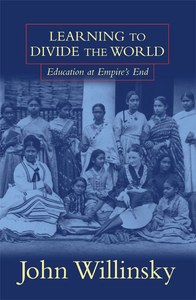
“The barbarian rules by force; the cultivated conqueror teaches.” This maxim from the age of empire hints at the usually hidden connections between education and conquest. In Learning to Divide the World, John Willinsky brings these correlations to light, offering a balanced, humane, and beautifully written account of the ways that imperialism’s educational legacy continues to separate us into black and white, east and west, primitive and civilized.
Considering a dazzling range of subjects, Willinsky discusses how the discovery of the New World inspired European culture with “the desire to take hold of the world . . . to enumerate, order, identify, and differentiate.” Willinsky reveals how this “will to know” became a foundation of the apparatus of imperialism, as shown in phenomena ranging from zoos to the British Museum to National Geographic. Through analyses of colonial schooling, anthropology, and the formation of academic subjects instrumental in the expansion of empire (history, geography, science, language and literature), Willinsky argues that education was and is the research and development arm of imperialism. Drawing on contemporary classrooms and materials, he considers how schools continue to educate the young within the “colonial imaginary.”
Learning to Divide the World is a beautifully written, well-organized, and cogently argued work. It is one of the more far-ranging and ambitious works on the topic of education and imperialism.
Peter McLaren, Graduate School of Education and Information Studies, UCLA; author of Revolutionary Multiculturalism: Pedagogies of Dissent for the New Millennium
“The barbarian rules by force; the cultivated conqueror teaches.” This maxim from the age of empire makes explicit the usually hidden connections between education and conquest. In Learning to Divide the World , John Willinsky brings these correlations to light, offering a balanced, humane, and beautifully written account of the ways that imperialism’s educational legacy continues to separate us into black and white, east and west, primitive and civilized.
Considering a dazzling range of subjects, Willinsky discusses how the discovery of the New World inspired European culture with “the desire to take hold of the world . . . to enumerate, order, identify, and differentiate.” Willinsky reveals how this “will to know” became a foundation of the apparatus of imperialism, as shown in phenomena ranging from zoos to the British Museum to National Geographic.
Through analyses of colonial schooling, anthropology, and the formation of academic subjects instrumental in the expansion of empire (history, geography, science, language and literature), Willinsky argues that education was and is the research and development arm of imperialism. Drawing on contemporary classrooms and materials, he considers how schools continue to educate the young within the “colonial imaginary.” Through primary texts, cutting-edge scholarship, and students’ voices, Willinsky examines schooling itself, arguing for the incorporation of the imperial legacy into a multicultural education that does not dismiss the achievement of the West but gives an account of the divided world that achievement has created.
Learning to Divide the World raises urgent questions about how colonialism and its attendant ways of learning gave rise to powerful ideas of race, culture, and nation that continue to influence us-and the children we are responsible for educating.
ISBN 0-8166-3076-3 Cloth/jacket $22.95
304 pages 11 halftones, 1 table, 1 figure 5 7/8 x 9 April
Translation inquiries: University of Minnesota Press
Awards
Winner of the 1999 American Educational Research Association Outstanding Book Award
Winner of the 1999 Outstanding Book Award from the History of Education Society
Winner of Honorable Mention from the Gustavus Myers Outstanding Book Award
Learning to Divide the World is a beautifully written, well-organized, and cogently argued work. It is one of the more far-ranging and ambitious works on the topic of education and imperialism.
Peter McLaren, Graduate School of Education and Information Studies, UCLA; author of Revolutionary Multiculturalism: Pedagogies of Dissent for the New Millennium
Learning to Divide the World is not simply a book of exemplary scholarship, but also one of passion and compassion. John Willinsky seeks to stir in us an understanding for those who are different by recognizing that the differences are within us. He shows us how the sense of difference that has divided people so brutally was manufactured, and how it might be healed.
Kieran Egan, Simon Fraser University, author of The Educated Mind: How Cognitive Tools Shape Our Understanding
Willinsky asks us to reevaluate our entire schema and to flip our collective worldview on its very head, imploring us to forge and advance a far more enlightened ‘postcolonial’ approach in our classrooms. Every now and then I read a book that leaves me with the thought, ‘I wish I had written that book!’ Learning to Divide the World is indisputably one such book. In fact, I shall go so far as to declare the following: If every (human) geographer were limited to reading only one new book this year, I would fervidly encourage them to read this one; and for those who teach our intro courses, and especially the regional ones, this book is quite simply indispensable. It may very well be the most cross-disciplinary book written by a professor of education this decade. It is no small feat to encapsulate the 500-year-long educational history and legacy of imperialism in only a few hundred pages, but John Willinsky has done just that. I thoroughly recommend this book.
Annals of the Association of American Geographers
Willinsky eloquently argues that the colonial legacy lives on in the hearts and minds of those educated, all over the world, in geographic, racial, and cultural categories crafted by European colonialists. A thoughtful examination of the changing mission of education in a multicultural world.
Kirkus Reviews
Describes how colonialism and imperialism shaped the Western way of thinking and how Westerners were educated.
Library Journal
The author’s main thesis is that imperialism lingers as a ‘trace element’ in educational systems. Even though empires disappeared within the space of a generation, they continue to shape the ways in which the world is viewed.
College and Research Libraries
Willinsky’s work has made a significant and generous contribution to the current academic debate about properly defining universal, national, regional, local, and individual historical narratives. I recommend this book for an enlightening journey, laden with personal reflection, challenges, responsibilities, and possibilities facing educators today.
Comparative Education Review
Learning to Divide the World offers designers and teachers of school and university curricula and of the ‘exhibitionary formations’ of public culture a secure and suggestive basis on which to go about learning to reunite the world. This book should be read and discussed in classrooms and boardrooms across Canada.”-University of Toronto Quarterl
Letters in Canada
A valuable way of introducing important questions to future educators. Learning to Divide the World inspires [them] to find ways to make their students more aware of the persistence of imperial thinking.
Interventions