Organizing Urban America
Secular and Faith-based Progressive Movements
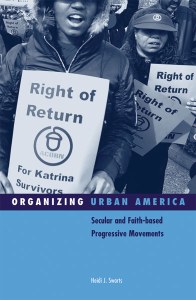
Heidi J. Swarts explores activist groups’ cultural, organizational, and political strategies. Focusing on ACORN chapters and church federations, Swarts demonstrates how congregation-based organizing has developed an innovative cultural strategy, and how ACORN’s national structure allows it to coordinate campaigns quickly. By making these often-invisible grassroots organizers evident, Swarts sheds light on factors that constrain or enable other social movements in the United States.
Organizing Urban America illuminates, in rich and textured detail, two contrasting mobilization cultures: one congregation based and the other a more classical, Alinsky-type community organizing model.
William Gamson, Boston College
Collective action through organized social movements has long expanded American citizens’ rights and liberties. Recently, the Association of Community Organizations for Reform Now (ACORN) has helped win living wage initiatives in more than 130 cities across the country. Likewise, congregation-based groups have established countless social programs at city and state levels. Despite modest budgets, these organizations—different in their approach, but at the same time working for social change—have won billions of dollars in redistributive programs.
Looking closely at this phenomenon, Heidi J. Swarts explores activist groups’ cultural, organizational, and political strategies. Focusing on ACORN chapters and church federations in St. Louis, Missouri, and San Jose, California, Swarts demonstrates that congregation-based organizing has developed an innovative cultural strategy, combining democratic deliberation and leadership development to produce a “culture of commitment” among its cross-class, multiracial membership. By contrast, ACORN’s more homogeneous low-income class base has a national structure that allows it to coordinate campaigns quickly, and its seasoned staff excels in tactical innovations. By making these often-invisible grassroots organizers evident, Swarts sheds light on factors that constrain or enable other social movements in the United States.
Organizing Urban America illuminates, in rich and textured detail, two contrasting mobilization cultures: one congregation based and the other a more classical, Alinsky-type community organizing model.
William Gamson, Boston College
Heidi Swarts reveals the promise of community organizing for giving voice to people who have been left out of America’s unequal democracy. This is an important book that points the way toward a more inclusive and responsive democratic politics.
Margaret Weir, University of California, Berkeley
In the wake of a presidential election in which ‘community organizer’ functioned as both praise and denigration, Swarts provides a welcome elaboration of how this role represents a distinctive model of political mobilization.
Political Science Quarterly
She presents fresh data in a succinct yet comprehensive manner, with a unique comparative method that makes Swarts’s work a valuable addition to the expanding literature on this terrain, providing further insight into the interworkings of community organizations and their constituents. As community organizing continues to influence public policy at greater levels, Organizing Urban America will be an important reference to explicate the variety of mobilizing strategies organizers employ.
Journal for the Scientific Study of Religion
A smart and provocative comparative study.
Social Services Review
Organizing Urban America. . . is of great value for social movement scholars and practitioners interested in how the internal life of a local grassroots organization is critical to its success. This clearly written, accessible book not only demonstrates different styles of organizing between secular and church-based groups, but shows how seemingly underrepresented groups of society can become empowered, get a voice and effect positive change.
Interface
Swarts’s first contribution to social movement studies is to highlight that culture is more than collective identity, framing, or even a toolkit employed by actors. Her complex and nuanced picture of social movements is applicable across a spectrum wider than the cases examined in this book.
Canadian Journal of Sociology
4/02/2010
ACORN is dead—maybe. Long live ACORN.
The national community-organizing group has been near-destroyed by sustained attacks from the right wing because of its very effectiveness. While some state and local groups have reconstituted themselves, they aren’t ACORN (Association of Community Organizations for Reform Now), the single centralized national organization. As I argue in Organizing Urban America, ACORN’s unique national strategy made a major contribution to the American progressive sector.