A Women’s Berlin
Building the Modern City

Around the beginning of the twentieth century, women began to claim Berlin as their own, expressing a vision of the capital that embraced their feminine modernity, both culturally and architecturally. A Women’s Berlin retraces this largely forgotten city, which came into being in the years between German unification in 1871 and the demise of the monarchy in 1918 and laid the foundation for a novel experience of urban modernity.
Despina Stratigakos takes us on a fascinating journey into a largely forgotten city at the heart of early 20th century metropolitan Berlin. Both imaginary and physical, A Women’s Berlin is a space of agency in which women architects, designers, and patrons shaped not only a network of new institutions in the city, but also a modern female subjectivity and urban identity for themselves as public citizens.
Eve Blau, Harvard University
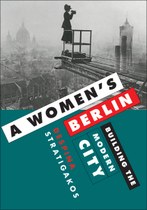
Around the beginning of the twentieth century, women began to claim Berlin as their own, expressing a vision of the German capital that embraced their feminine modernity, both culturally and architecturally. Women located their lives and made their presence felt in the streets and institutions of this dynamic metropolis. From residences to restaurants, schools to exhibition halls, a visible network of women’s spaces arose to accommodate changing patterns of life and work.
A Women’s Berlin retraces this largely forgotten city, which came into being in the years between German unification in 1871 and the demise of the monarchy in 1918 and laid the foundation for a novel experience of urban modernity. Although the phenomenon of women taking control of urban space was widespread in this period, Despina Stratigakos shows how Berlin’s concentration of women’s building projects produced a more fully realized vision of an alternative metropolis. Female clients called on female design professionals to help them define and articulate their architectural needs. Many of the projects analyzed in A Women’s Berlin represent a collaborative effort uniting female patrons, architects, and designers to explore the nature of female aesthetics and spaces.
At the same time that women were transforming the built environment, they were remaking Berlin in words and images. Female journalists, artists, political activists, and social reformers portrayed women as influential actors on the urban scene and encouraged female audiences to view their relationship to the city in a radically different light. Stratigakos reveals how women’s remapping of Berlin connected the imaginary to the physical, merged dreams and asphalt, and inextricably linked the creation of the modern woman with that of the modern city.
Awards
A Women's Berlin was awarded the Milka Bliznakov Prize by the International Archive of Women in Architecture (IAWA) Center, in Virginia Tech's College of Architecture and Urban Studies. The prize is awarded to scholarly or creative work that furthers the knowledge of women in architecture and the related design fields. It comes with a $1000 prize.
2009 DAAD Book Prize of the German Studies Association
This prize is funded through the North American office of the German Academic Exchange Service (DAAD) and carries an award of $1,000.
(1) The award for books in the fields of German language and literature, cultural studies, and the humanities is offered in even-numbered years. All books published during the preceding two years are eligible.
(2) The award for books in the fields of history, political science, and other social sciences is offered in odd-numbered years. All books published during the preceding two years are eligible.
Despina Stratigakos takes us on a fascinating journey into a largely forgotten city at the heart of early 20th century metropolitan Berlin. Both imaginary and physical, A Women’s Berlin is a space of agency in which women architects, designers, and patrons shaped not only a network of new institutions in the city, but also a modern female subjectivity and urban identity for themselves as public citizens.
Eve Blau, Harvard University
Stratigakos adds colour and distinction to a crucial period in Berlin's history. The interest of her study goes well beyond that of gender and architecture and contributes to a better understanding of the daily life of imperial Berlin. ‘Women and architecture’ is a topic that deserves more attention in general, and A Women's Berlin is an excellent example of how it can be done and of the illustrative quality such a study can have. This account of a ‘largely forgotten city, a site of both dreams and real spaces’ will fill a gap in any library on Berlin.
The Times Higher Education
A Women’s Berlin deserves to be read by anyone interested in the complex interaction between social change and the built environment.
European Architectural History Network
In this revision of a dissertation, Despina Stratigakos provides a delightful study of buildings by and for women in Berlin in the years before World War I.
German Studies Review
Clearly written, beautifully illustrated, and based on wide reading in archival and published sources, this book should be of great interest to all historians of modern Germany, of women’s history, and of architecture.
German Studies Review
Stratigakos has done us a great service by investing the important architectural movement of Wilhelmine Germany with the question of gender. . . . Her volume will be unavoidable reading for anyone wishing to have a critical and more comprehensive understanding of the development of Berlin as a major architectural centre.
The Journal of Architecture
Through the use of materials from the IAWA and the many German archives, a completely hidden history is uncovered to expand and deepened understanding of the contributions women architects made to the city and to the profession. The research is framed by social history that finds its expression in built form, and identifies largely unknown patrons and practitioners. It is illuminating, thorough, original, and an important contribution to the field.
Donna Dunay, to Virginia AIA News
A groundbreaking piece of scholarship building bridges among gender studies, cultural history, and architecture, A Women’s Berlin is an essential addition to any institutional library or specialized bibliography.
Journal of the Society of Architectural Historians
Stratigakos has succeeded in crafting a highly readable and fascinating account that is a well-researched contribution to both Wilhelmine and Weimar scholarship.
Journal of Design History
Stratigakos’s innovative and thoroughly documented approach sheds new light on women’s and on Berlin’s history.
The German Quarterly
In this respect, the book is entirely successful and offers a very readable account of five specific case studies that appeal to a wide audience—gender studies, architectural history, urban studies and human geography, to name just a few. This is, with no doubt then, a much-needed book that highlights a somewhat neglected narrative of urban modernity.
Urban Studies
The book, which received the prestigious 2009 Book Prize from the DAAD, is very well researched and illustrated. The author achieves what she sets out to argue, offering a conceptualization and imagination of a city through the lens of women.
Leonardo Reviews
Stratigakos combines meticulous archival scholarship and vivid, intelligent analysis of her material to recreate an episode of rapid change and high expectation for working women.
Gender, Place and Culture
Blog link roundup: Despina Stratigakos's now-successful campaign for Architect Barbie.