Landscapes of Urban Memory
The Sacred and the Civic in India’s High-Tech City
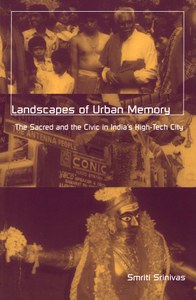
The city of Bangalore has become a center for high-technology research and production, the new “Silicon Valley” of India. It is also the site of the very popular annual performance called the “Karaga” dedicated to Draupadi, the polyandrous wife of the heroes of the pan-Indian epic of the Mahabharata. Through her analysis of this performance and its significance, Smriti Srinivas highlights cultural practices embedded in urbanization, and moves beyond economistic arguments about globalization.
A beautifully conceived work, Landscapes of Urban Memory is theoretically sophisticated, empirically grounded, and engaging. Srinivas has the rare ability to present impeccable scholarship with clarity and vividness.
Barbara Kirshenblatt-Gimblett, author of Destination Culture: Tourism, Museums, and Heritage
Established in the middle of the sixteenth century, Bangalore has today become a center for high-technology research and production, the new “Silicon Valley” of India, with a metropolitan population approaching six million. It is also the site of the very popular annual performance called the “Karaga” dedicated to Draupadi, the polyandrous wife of the heroes of the pan-Indian epic of the Mahabharata.
Through her analysis of this performance and its significance for the sense of the civic in Bangalore, Smriti Srinivas shows how constructions of locality and globality emerge from existing cultural milieus and how articulations of the urban are modes of cultural self-invention tied to historical, spatial, somatic, and ritual practices. The book highlights cultural practices embedded in urbanization, and moves beyond economistic arguments about globalization or their reliance on the European polis or the American metropolis as models.
Drawing from urban studies, sociology, anthropology, performance studies, religion, and history, Landscapes of Urban Memory greatly expands our understanding of how the civic is constructed.
A beautifully conceived work, Landscapes of Urban Memory is theoretically sophisticated, empirically grounded, and engaging. Srinivas has the rare ability to present impeccable scholarship with clarity and vividness.
Barbara Kirshenblatt-Gimblett, author of Destination Culture: Tourism, Museums, and Heritage
Srinivas brings together material from diverse sources to produce this extremely well-researched piece of work. Most importantly, the book is a valuable contribution to scholarship on processes of modernization and change in contemporary urban contexts, effectively demonstrating how ritual performance enables disadvantaged groups to reclaim their city for themselves by reconfiguring its spatial, temporal, and narrative history to their advantage.
American Ethnologist
This book is a real work, both empirically and analytically. In this book, Srinivas offers a model for understanding urban memory that must now be read, not just for its insights into religious performances in Bangalore, but for the questions it now sets for understanding urban memory elsewhere-including here.
American Journal of Sociology
This important book signals the value of bringing theory in the human sciences to bear on the study of Indian complexities, which is to say that it is a work of disciplined interdisciplinary reflection on some fascinatingly interrelated topics.
Journal of Asian Studies
Smriti Srinivas’s beautiful book presents a rich analysis of the relationship between urban spaces, symbolic forms, and political meanings.
Urban Affairs Review
This books makes a very important contribution to our understanding of religious practice, and of the organization of human communities, through its focus on the city. This focus is particularly significant given the fact that, overwhelmingly, earlier scholarship on religion and society in contemporary South Asia has centered around the village. As cities increasingly become places where people make their homes and livelihoods and create social identities and religious meanings, Srinivas’s study of Bangalore, in southern India, is indeed timely. Srinivas is wholly persuasive in her argument for the importance of ‘the civic’ as a category of analysis and provides an excellent discussion and review of the relevant scholarship. A very valuable contribution.
Journal of Contemporary Religion
Contents
Note on Transliteration and Translation
List of Illustrations
List of Tables
List of Abbreviations
Acknowledgments
Introduction
1. Civic Rituals in the New "Silicon Valley"
2. Models of the Garden City
3. The Urban Performative Complex
4. The Children of Fire
5. The Primal Goddess, the Polyandrous Spouse, and Celibate Warriors
6. Cities and Forests
Conclusion
Appendix: Survey of Vahnikula Kshatriya Households in Bangalore
Notes
Glossary
Bibliography
Index