Stupendous, Miserable City
Pasolini’s Rome
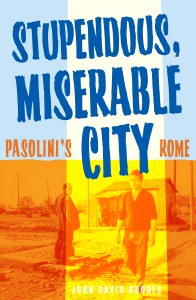
John David Rhodes places the city of Rome at the center of this in-depth examination of the work of Italian director Pier Paolo Pasolini—but it’s not the classical Rome you imagine. Discussing films such as Accattone, Mamma Roma, and The Hawks and the Sparrows, Rhodes shows how Pasolini used the public housing on the periphery of the city to draw attention to the contemptuous treatment of Rome’s poor.
In this remarkable book, John David Rhodes makes an invaluable contribution to scholarship on cinema and the city. Analyzing Pier Paolo Pasolini’s Rome films and his political and emotional engagement with the city, Rhodes has provided a fascinating and moving background to this period of Pasolini’s life, vision, and politics.
Laura Mulvey, professor of film, Birkbeck College, University of London
John David Rhodes places the city of Rome at the center of this original and in-depth examination of the work of Italian director Pier Paolo Pasolini—but it’s not the classical Rome you imagine. Stupendous, Miserable City situates Pasolini within the history of twentieth-century Roman urban development. The book focuses first on the Fascist period, when populations were moved out of the urban center and into public housing on the periphery of the city, called the borgate, and then turns to the progressive social housing experiments of the 1950s. These environments were the settings of most of Pasolini’s films of the early to mid-1960s.
Discussing films such as Accattone, Mamma Roma, and The Hawks and the Sparrows, Rhodes shows how Pasolini used the borgate to critique Roman urban planning and neorealism and to draw attention to the contemptuous treatment of Rome’s poor. To Pasolini, the borgate, rich in human incident, linguistic difference, and squalor, “were life”—and now his passion can be appreciated fully for the first time.
Carefully tracing Pasolini’s surprising engagement with this part of Rome and looking beyond his films to explore the interrelatedness of all of Pasolini’s artistic output in the 1950s and 1960s—including his poetry, fiction, and journalism—Rhodes opens up completely new ways of understanding Pasolini’s work and proves how connected Pasolini was to the political and social upheavals in Italy at the time.
In this remarkable book, John David Rhodes makes an invaluable contribution to scholarship on cinema and the city. Analyzing Pier Paolo Pasolini’s Rome films and his political and emotional engagement with the city, Rhodes has provided a fascinating and moving background to this period of Pasolini’s life, vision, and politics.
Laura Mulvey, professor of film, Birkbeck College, University of London
This work is extraordinary for combining shrewd aesthetic analysis with urban history. Its informed interdisciplinarity could transform Pasolini studies and other work as well. Highly recommended.
Choice
John David Rhodes portrays the social and aesthetic complexities of this world with the élan and precision of George Eliot. His outline history of Roman urbanism suggests voracious reading and many a walk through. Rhodes’s writing constantly surprises. This is an insightful, engrossing book about art, urbanism and consciousness that changes the way we think about Pasolini’s early career.
Sight & Sound
Stupendous, Miserable City provides a valuable and uniquely focused perspective on Pasolini’s life and works though a combination of literary and film analysis informed by urban historical and architectural study.
XCP: Cross Cultural Poetics
The interplay of formal analysis and historical context enables Rhodes to deftly expound on previous Pasolini scholarship in a clear and concise book. By asking specific questions about Rome in Pasolini’s work, this book contributes to and challenges existing discourses on Pasolini as well as Italian cinema and and cinema and the city more generally, an intervention of interest to scholars of Italian film and literature, but also for visual cultural scholars interested in questions of media and urban space . . . Rhodes is able to present a thorough and focused analysis on Pasolini’s early films.
Discourse
Stupendous, Miserable City compels us to reconsider the urban discourses that stimulated Pasolini as fundamental interpretive frameworks for some of his finest work. It is refreshing to read a thoroughly researched academic study written is so accessible and engaging a style, propelled along by the author’s palpable enthusiasm for his subject and mastery of the architecture and design of Pasolini’s inimitable vision.
Modernism/Modernity
Succeeds in bringing out Pasolini’s obsession with peripheral Rome and its importance for his films.
Journal of Modern Italian Studies
Rhode’s style is crisp and sometimes humorous. And his line of argumentation is clear. More importantly, the material is fresh, and his analysis convincing. This combination of traits makes not only for a pleasant read but also an illuminating journey to what once were the margins of Rome.
Italian Culture
Compact and clearly written, and studiously avoiding fashionable theoretical jargon, Rhodes’s book amply succeeds in its stated aim of exploring the deep connection between Rome and Pasolini’s early filmmaking and is therefore a valuable addition to the vast array of literature that exists on this great director.
Screening the Past
By keeping taut Pasolini’s careful intertwining of landscape, historical subjectivity, and economics, Rhodes has reanimated a crucial cinematic praxis for new audiences and scholars. In fact, this book’s focus on landscape masterfully maintains that tension while making its intervention palpable to those outside Pasolini’s historical and geographical situation.
The Cambridge Quarterly
Stupendous, Miserable City: Pasolini’s Rome is a rich account of Passolini’s deeply emotional relationship with this city and explores the role that Rome played on Passolini’s aesthetics through his films and literary work. The uniqueness of this book lies in the author’s success in linking the metaphorical and allegorical meaning in Passolini’s iconographies with their roots in the historical, urban and architectural contexts of post-WWII Rome, supported in this effort by an unprecendented collection and analysis of a large volume of factual information. . . the book remains a fascinating journey into the world of Passolini’s films and is an original and worthy contribution to the scholarship of film studies, adding a much-needed layer of urban and historical contextualisation to the body of work on this great intellectual.
Urban Studies Journal