Solidarity and Contention
Networks of Polish Opposition
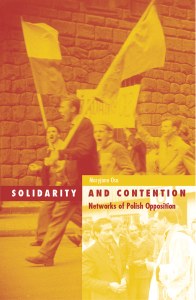
Solidarity and Contention deftly reconstructs the networks of protest in Communist Poland to show how waves of dissent during the 1950s, 1960s, and 1970s left an organizational residue that both instructed and enabled Solidarity and, ultimately, the Polish revolution. Using newly available documentary sources, Maryjane Osa shows how political challengers developed an ideological formula to facilitate coalition building.
In Solidarity and Contention, sociologist Maryjane Osa makes a major contribution to our understanding of how opposition emerges and develops.
Journal of Modern History
After a series of failed attempts at mobilizing society, Poland’s opposition sprang to surprising—and newly effective—life with the formation of the Solidarity trade union in 1980. If not for those past failures, this book suggests, Solidarity might never have succeeded. Solidarity and Contention deftly reconstructs the networks of protest in Communist Poland to show how waves of dissent during the 1950s, 1960s, and 1970s left an organizational residue that both instructed and enabled Solidarity and, ultimately, the Polish revolution.
Using newly available documentary sources, Maryjane Osa establishes links between activists during three waves of protest: 1954 to 1959, 1966 to 1970, and 1976 to 1980. She shows how political challengers, applying lessons drawn from past failures, developed an ideological formula to de-emphasize divisive issues and promote symbolic concerns, thus facilitating coalition building. Solidarity was therefore able to take advantage of a large opposition network already well in place before the founding of the union. An important case study in itself, the book also answers one of the most intriguing questions in social movement research: how can movements emerge in authoritarian states—where media are state controlled, the rights of assembly and speech are restricted, and the risks of collective action are high?
In Solidarity and Contention, sociologist Maryjane Osa makes a major contribution to our understanding of how opposition emerges and develops.
Journal of Modern History
Solidarity and Contention deals with the issue of how collective action is possible in nondemocratic societies. Students of social movements in a variety of contexts will find many useful ideas in this book.
Journal of Interdisciplinary History
A significant addition to the literature on postwar social movements in Poland.
American Journal of Sociology
Maryjane Osa’s book offers a fresh take on Poland’s anticommunist mass protest mobilization by treating it as a movement culture. The book offers one of the most nuanced discussions to date of the church’s program of the ‘Great Novena of the Millennium.’ Osa’s study of the Polish opposition movement under communism also offers a fresh look at how such movements diverge from democratic processes.
Slavic Review
Maryjane Osa’s book performs a major service by examining three waves of protest in Poland between the early 1950s and the early 1980s. She shows how protest was organized in terms of the networks and frames that coordinated protest, and addresses why only the last of these three protest waves (Solidarity) developed into a sustained movement.
Mobilization