Money and Liberation
The Micropolitics of Alternative Currency Movements
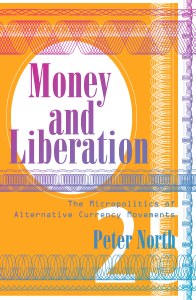
Money and Liberation examines the experiences of groups who have tried to build a more equitable world by inventing new forms of money. Presenting profiles of the trading networks that have been constructed, including Local Exchange Trading Schemes (England), and Green Dollars (New Zealand), Peter North shows how the use of currency has been redefined as part of political action.
Money and Liberation is an invaluable, fair-minded guide to alternative currency movements by an acknowledged expert in the field. Forward to different and more expansive notions of what constitutes the economy and the economic!
Nigel Thrift, author of Knowing Capitalism
Is conventional money simply a discourse? Is it merely a socially constructed unit of exchange? If money is not an actual thing, are people then free to make collective agreements to use other forms of currency that might work more effectively for them? Proponents of “better money” argue that they have created currencies that value people more than profitability, ensuring that human needs are met with reasonable costs and decent wages—and supporting local economies that emphasize local sustainability. How did proponents develop these new economies? Are their claims valid?
Grappling with these questions and more, Money and Liberation examines the experiences of groups who have tried to build a more equitable world by inventing new forms of money. Presenting in-depth profiles of the trading networks that have been constructed both historically and more recently, including Local Exchange Trading Schemes (England), Green Dollars (New Zealand), Talente (Hungary), and the barter system in Argentina, Peter North shows how the use of currency has been redefined as part of political action, revealing surprising political ambiguity and a nuanced understanding of the potential and limits on alternative currencies as a resistance practice.
Money and Liberation is an invaluable, fair-minded guide to alternative currency movements by an acknowledged expert in the field. Forward to different and more expansive notions of what constitutes the economy and the economic!
Nigel Thrift, author of Knowing Capitalism
Read this book to find fascinating accounts of alternative currencies, past and present. Peter North weaves archival material, revealing paradoxes, extracting lessons, and persuasively advocating that we continue to innovate with money and markets.
J.K. Gibson-Graham, University of Massachusetts, Amherst, and The Australian National University, Canberra
Money and Liberation is a fascinating and rewarding read.
The Sociological Review
You will find inspiration and information in this excellent book.
GreenWorld
If ever there was a single time or place for thinking about economic alternatives, including ways of representing economic geography outside the globalization narrative, here and now offers a suitably propitious moment to consider Peter North’s excellent book on Money and Liberation. This book offers a passionate and yet appropriately sanguine investigation into the alternative geographies of economics. It amounts to a significant contribution to rethinking the economy outside pre-given relational narrative frameworks of capital flows and globalization.
Journal of Economic Geography
It is rare that you read a book so good—so incisive in its analysis, radical in its prescriptions, and thorough in its evidence—that it makes you not only envious but quite literally angry that you did not write it yourself. I found Pete North’s new book on money that good. He has traveled widely in space and time to bring a depth of analysis missing from other books which cover some of the same territory.
Review of International Political Economy
Peter North’s optimistic argument should help to reinvigorate and redirect the discussion of economic alternatives for a long time to come.
Economic Geography
It is rare that you read a book so good—so incisive in its analysis, radical in its prescriptions, and thorough in its evidence—that it makes you not only envious but quite literally angry that you did not write it yourself. I found Pete North’s new book on money that good. He has traveled widely in space and time to bring a depth of analysis missing from other books which cover some of the same territory.
Review of Radical Political Economics
North’s social science approach is a welcome complement, creating a more grounded, complex portrait of what alternative currencies actually look like.
American Journal of Sociology