Dangerous Liaisons
Gender, Nation, and Postcolonial Perspectives
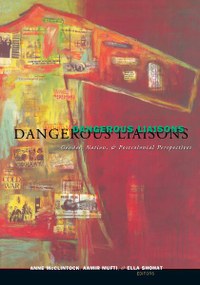
In this essential volume, eminent contributors address the issues raised by the postcolonial condition, considering nationhood, history, gender, and identity from an interdisciplinary perspective.
Contributors: Norma Alarcón, Kwame Anthony Appiah, Homi Bhabha, Judith Butler, Hazel V. Carby, Manthia Diawara, Arif Dirlik, Roberto Fernández Retamar, Jean Franco, Stuart Hall, M. Annette Jaimes Guerrero, Theresa Halsey, Michael Hanchard, bell hooks, Audre Lorde, Wahneema Lubiano, Kobena Mercer, Trinh T. Minh-ha, Chandra Talpade Mohanty, Rob Nixon, Gyan Prakash, Madhava Prasad, Edward W. Said, Gayatri Chakravorty Spivak, Robert Stam, Ann Laura Stoler, Gauri Viswanathan.
Please buy this book. You’ll be glad you did.
The Diversity Factor
Most people in the world, from Africa to Asia and beyond, live in the aftermath of colonialism. Their day-to-day lives are defined by their past history as colonized peoples, often in ways that are subtle or hard to define. In Dangerous Liaisons, eminent contributors address the issues raised by the postcolonial condition, considering nationhood, history, gender, and identity from an interdisciplinary perspective.
Among the questions they address are: What are the boundaries of race and ethnicity in a diasporic world? How have women been so effectively excluded from national power? What have been the historical aftermaths of different forms of colonialism? What are the cultural and political consequences of colonial partitions of the nation-state? Representing an essential intervention, Dangerous Liaisons is a crucial guidebook for those concerned with understanding postcoloniality at the moment when it is becoming more and more widely discussed.
Contributors: Norma Alarcón, U of California, Berkeley; Kwame Anthony Appiah, Harvard U; Homi Bhabha, U of Chicago; Judith Butler, U of California, Berkeley; Hazel V. Carby, Yale U; Manthia Diawara, NYU; Arif Dirlik, Duke U; Roberto Fernández Retamar, Havana U, Cuba; Jean Franco, Columbia U; Stuart Hall, Open U, England; M. Annette Jaimes Guerrero, San Francisco State U; Theresa Halsey; Michael Hanchard, U of Texas; bell hooks, CUNY; Audre Lorde; Wahneema Lubiano, Princeton U; Kobena Mercer; Trinh T. Minh-ha, U of California, Berkeley; Chandra Talpade Mohanty, Hamilton College; Rob Nixon, Columbia U; Gyan Prakash, Princeton U; Madhava Prasad; Edward W. Said, Columbia U; Gayatri Chakravorty Spivak, Columbia U; Robert Stam, NYU; Ann Laura Stoler, U of Michigan; Gauri Viswanathan, Columbia U.
Please buy this book. You’ll be glad you did.
The Diversity Factor
Dangerous Liaisons is one of the best postcolonial studies collections available.
MultiCultural Review
Here at last is a book that does not surrender to tired comparisons between capitalism and socialism, that takes monumentally critical themes and treats them with the seriousness and clarity they deserve.
CHOICE
Dangerous Liaisons is shaped around four overlapping areas of concern: colonial discourse and the question of the nation, diasporic identities and multicultural agendas, the intertwined politics of gender/sexuality and race within the double context of nationalism and feminism, and, finally, the debate abut the ‘postcolonial’ as conjecture and perspective. Here at last is a book that does not surrender to tired comparisons between capitalism and socialism, that takes monumentally critical themes and treats them with the seriousness and clarity they deserve. Important for general readers and beginning to advanced researchers.
Choice
Dangerous Liaisons uses postcolonial analysis, theory and criticism to address the constructions of nation, race, and gender in the Third World. The book is a fascinating and interestingly varied collection of pieces on postcolonial perspectives.
Ethnic Conflict Research Digest
Dangerous Liaisons successfully showcases some of the more politically engaged postcolonial criticism emerging in the last eighteen years.
Signs