Mechademia 3
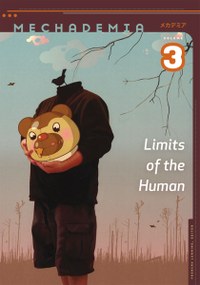
Limits of the Human
Contributors: William L. Benzon, Lawrence Bird, Christopher Bolton, Steven T. Brown, Joshua Paul Dale, Michael Dylan Foster, Crispin Freeman, Marc Hairston, Paul Jackson, Thomas LaMarre, Antonia Levi, Margherita Long, Laura Miller, Hajime Nakatani, Susan Napier, Natsume Fusanosuke, Sharalyn Orbaugh, Ôtsuka Eiji, Adèle-Elise Prévost and MUSEbasement; Teri Silvio, Takayuki Tatsumi, Mark C. Taylor, Theresa Winge, Cary Wolfe, Wendy Siuyi Wong, and Yomota Inuhiko.
Mechademia 3 is a fascinating read into the many different aspects of history and culture of Japan and how it has affected the world. It’s a smart read, but never so smart that it gets ahead of itself or that it isn’t understandable. It has a really great balance, and could easily be recommended to any anime fan with a thirst for insight beyond just watching a show, or being a fan.
Activeanime.com
Dramatic advances in genetics, cloning, robotics, and nanotechnology have given rise to both hopes and fears about how technology might transform humanity. As the possibility of a posthuman future becomes increasingly likely, debates about how to interpret or shape this future abound. In Japan, anime and manga artists have for decades been imagining the contours of posthumanity, creating dazzling and sometimes disturbing works of art that envision a variety of human/nonhuman hybrids: biological/mechanical, human/animal, and human/monster. Anime and manga offer a constellation of posthuman prototypes whose hybrid natures require a shift in our perception of what it means to be human.
Limits of the Human—the third volume in the Mechademia series—maps the terrain of posthumanity using manga and anime as guides and signposts to understand how to think about humanity’s new potentialities and limits. Through a wide range of texts—the folklore-inspired monsters that populate Mizuki Shigeru’s manga; Japan’s Gothic Lolita subculture; Tezuka Osamu’s original cyborg hero, Atom, and his manga version of Fritz Lang’s Metropolis (along with Ôtomo Katsuhiro’s 2001 anime film adaptation); the robot anime, Gundam; and the notion of the uncanny in Ghost in the Shell 2: Innocence, among others—the essays in this volume reject simple human/nonhuman dichotomies and instead encourage a provocative rethinking of the definitions of humanity along entirely unexpected frontiers.
Contributors: William L. Benzon, Lawrence Bird, Christopher Bolton, Steven T. Brown, Joshua Paul Dale, Michael Dylan Foster, Crispin Freeman, Marc Hairston, Paul Jackson, Thomas LaMarre, Antonia Levi, Margherita Long, Laura Miller, Hajime Nakatani, Susan Napier, Natsume Fusanosuke, Sharalyn Orbaugh, Ôtsuka Eiji, Adèle-Elise Prévost and MUSEbasement; Teri Silvio, Takayuki Tatsumi, Mark C. Taylor, Theresa Winge, Cary Wolfe, Wendy Siuyi Wong, and Yomota Inuhiko.
Mechademia 3 is a fascinating read into the many different aspects of history and culture of Japan and how it has affected the world. It’s a smart read, but never so smart that it gets ahead of itself or that it isn’t understandable. It has a really great balance, and could easily be recommended to any anime fan with a thirst for insight beyond just watching a show, or being a fan.
Activeanime.com
With volume three, Mechademia has finally hit its stride. . . . Mechademia has achieved a new level of excellence. If you love anime and manga and want to go beyond just the entertainment value of these art forms, then you must get a subscription to Mechademia. It will help you better understand the Japanese culture, history, religion, and philosophy behind these works.
Comics Worth Reading
Mechademia’s accessible format and topics, especially for fanboys and fangirls, encourages a broad look that mostly rewards.
M/C Reviews
This third volume shows the journal clearly establishing a serious identity of its own and as such provides a vital platform for intelligent discussions of anime and manga.
Midnight Eye
The volume contains highly eclectic and unique analyses of a genre that is swiftly gaining popular and critical momentum in Western culture. One does not have to be an anime/manga scholar or aficionado to appreciate it.
Science Fiction Studies