Growing up Global
Economic Restructuring and Children’s Everyday Lives
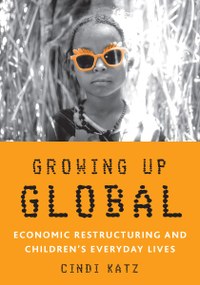
Growing Up Global examines global change through children’s lives in two seemingly disparate places: New York City and Sudan.
The book’s core is a study of children in a Sudanese village that was included in a state-sponsored agricultural program. Shifting her focus to working-class families in New York City, Cindi Katz exposes connections with the Sudanese in the effects of a capitalist environment on children.
Growing Up Global is a valuable new addition to the growing list of critical ethnographies of globalization. Cindi Katz’s attention to spatiality and what she calls ‘time-space expansion’ offers a useful corrective to the familiar clichés of globalization as an abstract, world-shrinking force.
James Ferguson, author of Expectations of Modernity: Myths and Meanings of Urban Life on the Zambian Copperbelt
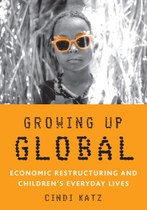
Growing Up Global examines the processes of development and global change through the perspective of children’s lives in two seemingly disparate places: New York City and a village in northern Sudan.
At the book’s core is a longitudinal ethnographic study of children growing up in a Sudanese village that was included in a large state-sponsored agricultural program in the year they were born. It follows a small number of children intermittently from ten years of age to early adulthood, concentrating particularly on their work and play, which together trained the children for an agrarian life centered around the family, a life that was quickly becoming obsolete.
Shifting her focus to largely working-class families in New York City in the 1980s and 1990s, Katz is able to expose unsuspected connections with the Sudanese experience in the effects on children of a constantly changing, capitalist environment—the decline of manufacturing jobs and the increase in knowledge-based jobs—in which young people with few skills and stunted educations face bleak employment prospects.
In teasing out how “development” transforms the grounds on which these young people come of age, Cindi Katz provides a textured analysis of the importance of knowledge in the ability of people, families, and communities to reproduce themselves and their material social practices over time.
Awards
Winner of the AAG Meridian Book Award for the Outstanding Scholarly Work in Geography
Growing Up Global is a valuable new addition to the growing list of critical ethnographies of globalization. Cindi Katz’s attention to spatiality and what she calls ‘time-space expansion’ offers a useful corrective to the familiar clichés of globalization as an abstract, world-shrinking force.
James Ferguson, author of Expectations of Modernity: Myths and Meanings of Urban Life on the Zambian Copperbelt
This is a book that I highly recommend; it brings to us an issue, a place, and a people that rarely make it into our political imaginations.
International Journal of Middle Eastern Studies
Growing up Global is a provocative account of development and global change through the perspective of children’s lives. These discussions add to our understanding of geographical knowledge and economic restructuring—combining globalization with children’s everyday lives. Anyone who is familiar with Katz’s work on globalization and topographical analysis will not be disappointed with, or surprised by, the impassioned analysis she has used here to understand these processes. This book and the critical geography it represents are a remarkable effort to bridge two seemingly different worlds in both time and space.
Annals of the Association of American Geographers
Overall, this is an illuminating, engaging, indeed, even moving, account. This book is likely to be viewed as a landmark text within a host of areas of research interest. I anticipate that Growing up Global will prove to be a significant resource for academics and students at a variety of undergraduate and graduate levels
Environment and Planning A
Brilliant and intimate. The book is an eloquent rendition of the expansive spatial abstractions and mimetic revolutionary re-imagination it proposes.
Social and Cultural Geography
Theoretically and empirically rich. Katz provides new theoretical tools with which to move beyond global/local debates and to construct comparative research projects.
Women’s Studies Quarterly
An eloquently prosaic, and readable narrative, effortlessly interweaving theoretical reflection with thick description. Katz beautifully exercises the craft of the ethnographer. This text provides a substantial and worthwhile analysis of the workings of globalization and its local impacts. Everyone should read this.
Children’s Geographies
In this remarkable and ambitious study, geographer Cindi Katz documents and theorizes connections between global capitalism and children’s lives. The work is anchored in political economy but draws on an impressive breadth of scholarship from many disciplines including anthropology, sociology, psychology, and geography. This book represents a tremendous achievement and contribution—a model for future research.
Canadian Journal of Sociology Online
Contributes substantially to the science of geography while the creativity of its spatial imagination enlivens the art of geography. With vivid prose and attractively illustrated by the author’s photographs, this book will appeal to many readers within, and beyond, geography.
Association of American Geographers Newsletter
In Growing Up Global, Katz takes up the question of power and inequality. Katz’s search is for a more distributive, concrete form of social justice.
Antipode
Growing Up Global should be read widely and closely, to open debate within geography about how one crafts ‘critical ethnographies’ across divergent social conditions, lived understandings, archival possibilities, and methodological limitations.
Environment and Planning D: Society and Space
Growing Up Global is rich with conceptual insight and observations that, in measures large and small, help enrich our understanding of the multiple processes and practices involved in Howa’s Disintegration. This book is peppered with casual but deeply insightful asides.
Annals of the Association of American Geographers
Cindi Katz is to be congratulated for having produced a magnificent work in Growing up Global. This is an inspiring book in which the author combines the craft of the ethnographer with incisive theoretical analysis, infused throughout with affectionate warmth for her research participants and collaborators.
International Development Planning Review
A sort of nourishment for an academic soul that seeks commitments to grounded research, to telling stories developed through the patience of engaged fieldwork (which rarely leads to quick conclusions), and to enjoying theories for what they are meant to do: to serve as the means of explanation rather than the ends.
Antipode
Contents
Preface
Part I. Fluid Dynamics
1. A Child's Day in Howa
2. The Political Economy and Ecology of Howa Village
Part II. Social Reproduction
3. Children's Work and Play
4. Knowing Subjects/Abstracting Knowledge
5. Disrupted Landscapes of Production and Reproduction
Part III. Displacements
6. New York Parallax; or, You Can't Drive a Chevy through a Post-Fordist Landscape
7. Howa at the End of the Millennium
Part IV. Topographies of Global Capitalism
8. The Strange Familiar
9. Negotiating the Recent Future
Appendix: Children's Work
Glossary: Colloquial Sudanese Arabic Terms
Acknowledgments
Notes
Works Cited
Index