American Exposures
Photography and Community in the Twentieth Century
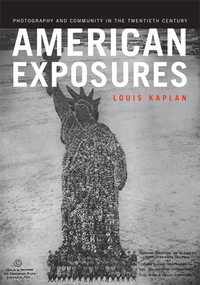
American Exposures sheds light on a wide range of photographs and asserts that the depiction of community is a central component to photography. From Edward Steichen's Family of Man exhibition to Pedro Meyer and the rise of the digital image, Louis Kaplan points to a new way to think about the intimate relationship among photography, American life, and the artistic imagination.
Without minimizing their differences, Louis Kaplan examines a heterogeneous set of works to demonstrate the many links between the practice of photography and endless efforts to delineate concepts of community. Few studies could be more relevant for rethinking the role of photography in the 'American' twentieth century.
Sally Stein, University of California, Irvine
Photographs have the power to define and shape a community of people—for those who are revealed as well as for those who view them. Louis Kaplan addresses this phenomenon through a constellation of innovative essays that draw on the artistic renderings of national, ethnic, and global community. Spanning the twentieth century and profusely illustrated, American Exposures sheds light on a wide range of photographs, from Arthur Mole’s propagandistic “living photographs” of American icons and symbols to the exploration of contemporary subcultural communities by the Korean-born photographer and performance artist Nikki Lee, and asserts that the depiction of community is a central component to photography.
Examining an eclectic collection of photographers, American Exposures deploys a number of critical concepts and theories developed by Jean-Luc Nancy in The Inoperative Community, as well as other philosophers, and applies them to the field of photography studies. Combining artistic and historical material with interdisciplinary theory, Kaplan moves beyond indexical thinking to demonstrate how an expository approach offers valuable resources with which to analyze visual communication. In doing so, he highlights the distinct powers of both community and photography as discourses of exposure.
With an original approach to photography from Edward Steichen’s Family of Man exhibition to Pedro Meyer and the rise of the digital image, Kaplan points to a new way to think about the intimate relationship among photography, American life, and the artistic imagination.
Without minimizing their differences, Louis Kaplan examines a heterogeneous set of works to demonstrate the many links between the practice of photography and endless efforts to delineate concepts of community. Few studies could be more relevant for rethinking the role of photography in the 'American' twentieth century.
Sally Stein, University of California, Irvine
Through an extremely detailed analysis, Kaplan presents an argument that is highly original and critically important, radically shifting both how we view the images that are the focus of his book and how they position their subjects within larger narratives of community and identity. Kaplan’s argument follows a sophisticated and precise trajectory, and is tightly presented, drawing form a wide range of fields, including philosophy, semiotics, and psychoanalysis. Kaplan’s book enables us to rethink many important historical images and also provides us with strategies for reading contemporary photographic practices. The end result of Kaplan’s work is a powerful destabilization of these categories and an original and important way of rethinking the terms of community.
The Art Book
Kaplan consistently shows how theory and practice can illuminate each other. A solid contribution to American studies and art history. Recommended.
Choice
Exceptionally challenging. American Exposures is astute and nasty, disturbing and liberating, and it is no exaggeration to say that Kaplan’s study will turn out to be a watershed publication. It is difficult, I think, to deny that American Exposures transforms our way of seeing photography, just as it is impossible to ignore the depth of many of his close readings or not to admire the intelligent intertwining of detailed visual analysis and theoretical reflections. A great book.
History of Photography
Louis Kaplan, in a well-researched and thoroughly documented work, has put forth a compelling case for the linking of traditional concepts of community with the relatively new art form of photography (‘community-exposed photography’).
M/C Media and Culture Reviews
Kaplan's powerful writing style, combined with his always enlightening readings of individual photographs and his complex interweaving of various theoretical and interdisciplinary strains, help make American Exposures the landmark study it is, one that will no doubt impact future discussions concerning that which makes photography such a vital medium in the understanding of what it means to be in community.
CAA Reviews
The text rewards with astute insights into the works of photographers a la mode.
American Studies
Related Publications


 Masterpiece Photographs of The Minneapolis Institute of Arts
The Curatorial Legacy of Carroll T. Hartwell
Masterpiece Photographs of The Minneapolis Institute of Arts
The Curatorial Legacy of Carroll T. Hartwell