Political Life in Cairo’s New Quarters
Encountering the Everyday State
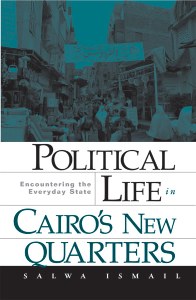
Since the 1970s, Cairo has experienced tremendous growth and change. Salwa Ismail examines the effects of these changes in Political Life in Cairo's New Quarters. Rich in ethnographic detail, this work reveals the city's new urban quarters as sites not only of opposition, but also under governmental surveillance, situating the everyday within the context of developments in Cairo.
Political Life in Cairo's New Quarters is an excellent book that makes a needed contribution to both the study of state society relations in the Middle East, and the study of space and politics in Cairo.
Nezar AlSayyad, University of California, Berkeley
Since the 1970s, Cairo has experienced tremendous growth and change. Nearly three million people now live in new urban communities characterized by unregulated housing, informal economic activity, and the presence of Islamist groups.
Salwa Ismail examines the effects of these changes in Political Life in Cairo’s New Quarters. Working in Cairo, Ismail interviewed new quarter residents, observed daily life in markets and alleyways, met with local leaders, and talked with young men about their encounters with the government. Rich in ethnographic detail, this work reveals the city’s new urban quarters as sites not only of opposition and relative autonomy, but also under governmental surveillance and discipline. In doing so, it situates the everyday within the context of wider developments in Cairo: the decline of welfarism, the shift to neoliberal government, and the rise of the security state.
Original and timely, Political Life in Cairo’s New Quarters highlights the interplay of structural changes, state power, and daily governance, and presents a fascinating analysis of urban transformation and power struggles—as international forces meet local communities in a major city of the global south.
Political Life in Cairo's New Quarters is an excellent book that makes a needed contribution to both the study of state society relations in the Middle East, and the study of space and politics in Cairo.
Nezar AlSayyad, University of California, Berkeley
Studies such as Ismail’s are thoroughly worthwhile.
Insight Turkey
Political Life in Cairo’s New Quarters is an excellent contribution to Middle Eastern studies, urban anthropology, and the studies of everyday politics and the nature of everyday structures of government and control.
American Ethnologist
Contents
Acknowledgments
A Note on Transliteration
Glossary of Arabic Terms
Introduction Space, Politics, and the Everyday State in Cairo
Chapter 1 Reconfiguring Cairo: New Popular Quarters between the Local and the Global
Chapter 2 Internal Governance: Forms and Practices of Government in Everyday Life
Chapter 3 Neoliberalism and the Relocation of Welfare
Chapter 4 Youth, Gender, and the State in Cairo: Marginalized Masculinities and Contested Spaces
Chapter 5 The Politics of Security: An Economy of Violence and Control
Postscript Collective Action and the Everyday State
Appendix A The “Field” and “Home”: The Politics of Location
Appendix B Thematic Outline of Interview Frames
Notes
Bibliography
Index
UMP blog Q&A: Egypt's unrelenting protests are rooted in many years of civil unrest and bear the marks of a social revolution.
2/03/2011
Q: What issues and emotions are at the heart of protests in Egypt?
A: The protests are to a large extent guided by a desire to assert citizens’ right to dignity and freedom in their own country.
Vast segments of Egyptian society have economic, social and political grievances that they have been articulating both in public discourse and action for more than a decade now with little response from the Mubarak regime. We have seen successive waves of protest by workers in both public- and private-sector industries, by professionals, university professors, civil servants and students. Read more ...