Circuits of Culture
Media, Politics, and Indigenous Identity in the Andes
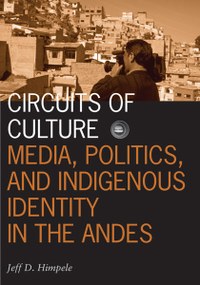
Set against the background of Bolivia’s prominent urban festival parades and the country’s recent appearance on the front lines of antiglobalization movements, Circuits of Culture is the first social analysis of Bolivian film and television, their circulation through the social and national landscape, and the emergence of the country’s indigenous video movement.
Jeff Himpele rejects the compartmentalization of mass, urban, popular, indigenous, and festival media in this brilliant study of media and identity. He has also provided an extraordinarily original framing of the social and cultural dynamics of a Latin American political economy.
Kay Warren, Watson Institute, Brown University
Set against the background of Bolivia’s prominent urban festival parades and the country’s recent appearance on the front lines of antiglobalization movements, Circuits of Culture is the first social analysis of Bolivian film and television, their circulation through the social and national landscape, and the emergence of the country’s indigenous video movement.
At the heart of Jeff D. Himpele’s examination is an ethnography of the popular television program The Open Tribunal of the People. The indigenous and underrepresented majorities in La Paz have used the talk show to publicize their social problems and seek medical and legal assistance from the show’s hosts and the political party they launched. Himpele studies the program in order to identify the possibilities of the mass media as a site for political discourse and as a means of social action.
Charting as well the history of Bolivia’s media culture, Himpele perceptively investigates cinematic media as sites for understanding the modernization of Bolivia, its social movements, and the formation of indigenous identities, and in doing so provides a new framework for exploring the circulation of culture as a way of creating publics, political movements, and producing media.
Jeff Himpele rejects the compartmentalization of mass, urban, popular, indigenous, and festival media in this brilliant study of media and identity. He has also provided an extraordinarily original framing of the social and cultural dynamics of a Latin American political economy.
Kay Warren, Watson Institute, Brown University
A richly detailed historical analysis of Bolivian film and television.
Choice
Himpele, in this book, has given us an exceptionally full picture of the Bolivian mediascape. Each part could constitute a full book topic in and of itself, and each would be rich. Yet it is together that they make the strongest contribution to the literature on cultural flow. Circuits of Culture stands out not only for its contributions to our understanding of the circulation of culture, but also for its contributions to the study of mass culture in the Andes. This eminently readable book manages to tie together a very thorough micro-level and macro-level investigation of the paths of culture. It stands as a worthwhile addition to the existing literature surrounding questions of power, representation, and identity in the circulation of media products.
International Journal of Communication
Himpele has written an excellent and challenging book that deserves a broad readership. For scholars of Bolivia, visual anthropology, and indigeneity, Circuits of Culture is a must-read.
A Contra Corriente
The importance of Himpele’s work should not be underestimated as it offers important analysis into the often overlooked area of study: film and media in Bolivia.
The Kelvingrove Review
An evolving subject-matter and evolving perspective requires and evolving methodology, and Himpele practices his fieldwork on Bolivian indigenism in city centers like La Paz—a decision that surprises many of his informants and consultants, who think that ‘real indigenous culture’ is in the distant mountain communities. However, Himpele’s point is well taken, and is essential to his entire project, that native peoples. . . live in the cities and that indigenous media is being created there. Even more, movies and television programs are hardly the only expression of indigenous culture in the city: he colorfully and significantly describes the ways in which ‘traditional’ practices like parades, festivals, and rituals compete with and intersect with ‘modern’ media.
Anthropology Review Database
Himpele performs an ethnographic service to his readers by offering a focused perspective of an emerging indigenous public media sphere, with increasing political consequence, that largely has been unobserved, unnoticed, unanalyzed, unarticulated, and thus unknown. At base this is a superb example of an intimately engaged, meticulously researched longitudinal ethnography.
media/anthropology