Hegemony and Power
On the Relation between Gramsci and Machiavelli
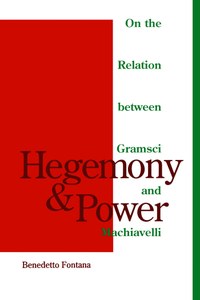
Presents a comparative and textual exploration of Gramsci’s interpretation of Machiavelli’s political anlayses. This valuable contribution to our understanding of Gramsci includes a comparison of the major Machiavellian ideas such as the nature of political knowledge, the new principality, the concept of the people, and the relation between thought and action, to Gramsci’s concepts of hegemony, moral and intellectual reform, and the collective will.
Fontana rescues Gramsci from many of the Gramscians by situating him in a provactively new perspective. Where other scholars became fixated on Lenin and the strategies of Bolshevism and the Italian Communist Party, Hegemony and Power more plausibly sees Gramsci as part of the Machiavellian tradition, an humanistic politics that attempts to synthesize knowledge and action and power and ethics. A fresh, learned work of political philosophy and intellectual history.
John Patrick Diggins, CUNY
Presents a comparative and textual exploration of Gramsci's interpretation of Machiavelli's political analyses. This valuable contribution to our understanding of Gramsci includes a comparison of the major Machiavellian ideas such as the nature of political knowledge, the new principality, the concept of the people, and the relation between thought and action, to Gramsci's concepts of hegemony, moral and intellectual reform, and the collective will.
Immensely valuable. Let it suffice here to say that from now on, all Gramsci scholars will have to take Fontana’s contribution into account in ways that are not merely incidental to this or that aspect of Gramsci’s political thought and conception of Marxism, but that are absolutely indispensable to an integrated understanding of his world view.
Rivista Di Studi Italiani
Fontana rescues Gramsci from many of the Gramscians by situating him in a provactively new perspective. Where other scholars became fixated on Lenin and the strategies of Bolshevism and the Italian Communist Party, Hegemony and Power more plausibly sees Gramsci as part of the Machiavellian tradition, an humanistic politics that attempts to synthesize knowledge and action and power and ethics. A fresh, learned work of political philosophy and intellectual history.
John Patrick Diggins, CUNY
Ben Fontana's book, Hegemony and Power, shows how the thought of Antonio Gramsci belongs at the very center of Western culture. Fontana argues that the way to read Gramsci is through Aristotle and Machiavelli, and that democratic communism evolves out of one of the deepest and most venerable traditions in Western thought, the tradition that scholars have come to call Civic Humanism. He opens up for us a Gramscian vision of the world whose center is a people that is politically awake and engaged. This vision has special bearing on the events of 1989. Ironically, the peoples whose mass mobilization and pressure brought down the USSR and its satellites may have helped the authentic idea of communism to come into its own. Fontana shows us the spiritual depth of this idea, and makes it clear that it will be with us as long as we have the capacity to reflect on our lives and our desires.
Marshall Bermon, City University of New York
By contrasting Gramsci's interpretation of Machiavelli with Croce's, Fontana presents a spare but surprisingly trenchant critique of liberalism. By locating Gramsci, like Machiavelli, within the tradition of civic republicanism, Fontana offers fresh and profound insights into Gramsci's thought and his significant, gap-filling role in the Marxian tradition.
Choice
Fontana’s angle of entry is a crucial one, for while Gramsci has indeed survived with honor even in self-designated ‘post-Marxist’ thinking, the sticking point remains Gramsci’s modernist insistence on the revolutionary necessity of an organized, mass-based political party. The insight and the awareness of both historical circumstances and philosophical positioning that Fontana brings to bear on Gramsci’s reading of Machiavelli seems to me an indispensable corrective to an all-to-familiar ‘post’ assumption that a party politics engaged in fundamental, global conflicts is merely a thing of the past.
American Political Science Review
Engaging and thoroughly readable. Through the lens of Gramsci’s writings, Fontana opens an unexpected and exciting space for dialogue between Florentine republicanism and Marxist humanism. This study will interest and provide a useful text for students concerned with the nature of modern politics in general. A valuable resource for anyone concerned with the problem of ideology, political knowledge and mass movements.
Millennium
This excellent work is the first book-length study on the relation between Gramsci and Machiavelli to be published in English.
Science and Society
As a study of reconstruction, as an antidote to the near-hegemony of postmodern discourse, Fontana’s study serves well. In an odd but nonetheless productive blending of elements from the work of Gramsci and Arendt, Fontana ably counters talk of the ‘end of politics’, and he cogently defends ‘the vitality and centrality of politics’.
Southern Humanities Review