Cartographic Cinema
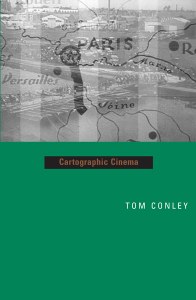
Maps and movies tell their viewers where they are situated, what they are doing, and, to a strong degree, who they are. In this groundbreaking work, eminent scholar Tom Conley establishes the ideological power of maps in classic, contemporary, and avant-garde cinema to shape the imaginary and mediated relations we hold with the world.
Cartographic Cinema is a fascinating and highly original project by one of the most influential scholars working in French studies and cinema studies today.
David Rodowick, author of Reading the Figural, or Philosophy after the New Media
Cartography and cinema are what might be called locational machinery. Maps and movies tell their viewers where they are situated, what they are doing, and, to a strong degree, who they are. In this groundbreaking work, eminent scholar Tom Conley establishes the ideological power of maps in classic, contemporary, and avant-garde cinema to shape the imaginary and mediated relations we hold with the world.
Cartographic Cinema examines the affinities of maps and movies through comparative theory and close analysis of films from the silent era to the French New Wave to Hollywood blockbusters. In doing so, Conley reveals that most of the movies we see contain maps of various kinds and almost invariably constitute a projective apparatus similar to cartography. In addition, he demonstrates that spatial signs in film foster a critical relation with the prevailing narrative and mimetic registers of cinema.
Conley convincingly argues that the very act of watching films, and cinema itself, is actually a form of cartography. Unlike its function in an atlas, a map in a movie often causes the spectator to entertain broader questions-not only about cinema but also of the nature of space and being.
Cartographic Cinema is a fascinating and highly original project by one of the most influential scholars working in French studies and cinema studies today.
David Rodowick, author of Reading the Figural, or Philosophy after the New Media
Tom Conley knows how to use the meditations on cartography to 'undress' the perverse mechanics of a film's unconscious constructions of desire and to link these to contemporary history, sociology, and ontology.
T. Jefferson Kline, Boston University
In this intriguing exploration of the interrelationship between cartography and the cinema, Conley places images from a wide variety of films—from surrealist silent classics to recent Hollywood films—within a map of dreams and actual locations. Conley’s approach is unique, and he makes intriguing, illuminating connections between, for example, Casablanca and the Indiana Jones films, among others, using frame blowups and detailed textual readings of the films to locate them in time and space. One is struck by the cast range of Conley’s discussion, which effortlessly embraces both contemporary popular films and established classics to create a unique taxonomy of action and desire. Conley’s rich, persuasive text delineates the many ways in which these imaginative journeys are constructed, along with the manner in which a film can reach beyond the confines of geography to create a special place in the spectator’s mind of memory. Recommended.
Choice
Conley’s argument for a cartographic method of reading film is persuasive and seductive, appealing to a viewer’s sense of intellectual play, ontological wonder, and emotional investment in the dislocation summoned up by the viewing experience.
Film Comment
Tom Conley’s book can be called a major achievement, both for clarity and profoundness of its theoretical insights and for the exceptional brio of its close readings. Moreover, Cartographic Cinema is not just a book that makes a strong plea for close reading but succeeds in demonstrating the theoretical necessity of this approach, provided it is articulated wit strong theoretical perspectives. As such, Tom Conley has written a book that is a major contribution to film studies (and other related fields) as well as an exciting collection of essays on the history of 20th-century cinema.
Leonardo Review
An important work of rich cultural complexity, with a clear political, social and cultural relevance for geographers and other critical scholars. The rich detail in the analyses and the innovative critique of the detailed case studies offer a persuasive and enjoyable polemic.
Progress in Human Geography
Contents
Acknowledgments
Introduction Theory and Cartography—Cinematic Taxonomy and Cartography— Archive and Diagram—Dislocation, Distance, Discretion—Mental Mapping and Mobile Topography—A Map in a Movie
1. Icarian Cinema: Paris qui dort A Site of Immaculate Origin—A Film in Flux—Two Spatial Stories— Points of Comparison—Liberty: A Vanishing Point
2. Jean Renoir: Cartographies in Deep Focus Boudu cartographe—Tracking a Revolution—La Grande illusion: Terrae incognitae—Globes In and Out of Perspective
3. Maps and Theaters of Torture: Roma, città aperta A Map Room—Italy Wallpapered: A Map in an Apartment— A Theater of Torture—Wiped Surfaces
4. A Desperate Journey: From Casablanca to Indiana Jones Crashing In and Crashing Out—A Map in a Montage—Desperate Journey—CamouXage—A Map-Dissolve: Casablanca—From Historical Geography to Melodrama—A Place Named—Indiana Jones
5. Juvenile Geographies: Les Mistons A Story Plotted into Film—Correspondence and Rewriting— Scenes of Writing—As the Crow Flies—Old Films and New Worlds: An Allegory
6. Michelin Tendre: Les Amants A Book and a Movie—“Attention au départ”—The Gleaner and the Grease Monkey—Pleats and Folds—The Michelin Map after La Carte du Tendre
7. Paris Underground: Les 400 coups The “Quarrel”—Credits—Class Room and Map Room— Mother and Mother France—A Child’s Map
8. A Roadmap for a Road Movie: Thelma and Louise Geography and Gentility—Cinematic Diagrams—A Map Room and a Baroque Motel—ReXectors and Benders—Orpheus Rewritten— The Map in the Picture—Women Plotted
9. Cronos, Cosmos, and Polis: La Haine Children of France—Events Crosscut—The Lower Depths— The World Is Ours—GrafWti and Glossolalia
10. Ptolemy, Gladiator, and Empire A Correspondence: Empire and Gladiator—Ptolemy’s Italia— Map Effects and Special Effects—Super Bowls—Aftereffects
Conclusion
Notes
Bibliography
Filmography
Index