Waves of Protest
Popular Struggle in El Salvador, 1925–2005
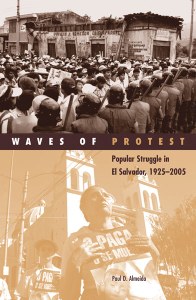
Providing a compelling analysis of the massive waves of protests from the early twentieth century to the present in El Salvador, Paul D. Almeida fully chronicles one of the largest and most successful campaigns against globalization and privatization in the Americas. In doing so, he brings negative political conditions to the forefront as central forces driving social movement activity in the developing world.
Paul D. Almeida has provided a first rate pioneering analysis of the impact of state repression and political controls on popular political action.
J. Craig Jenkins, Ohio State University
One of the first longitudinal studies of collective resistance in the developing world, Waves of Protest examines large-scale contentious action in El Salvador during critical eras in the country’s history.
Providing a compelling analysis of the massive waves of protests from the early twentieth century to the present in El Salvador, Paul D. Almeida fully chronicles one of the largest and most successful campaigns against globalization and privatization in the Americas. Drawing on original protest data from newspapers and other archival sources, Almeida makes an impassioned argument that regime liberalization organizes civil society and, conversely, acts of state-sponsored repression radicalize society. He correlates the ebb and flow of protest waves to the changes in regime liberalization and subsequent de-democratization and back to liberalization.
Almeida shows how institutional access and competitive elections create opportunity for civic organizations that become radicalized when authoritarianism increases, resulting at times in violent protest campaigns that escalate to revolutionary levels. In doing so, he brings negative political conditions and threats to the forefront as central forces driving social movement activity and popular contention in the developing world.
Paul D. Almeida has provided a first rate pioneering analysis of the impact of state repression and political controls on popular political action.
J. Craig Jenkins, Ohio State University
Waves of Protest makes a major contribution to Central American historical sociology and, more broadly, to the study of protest movements, collective action, and the state in this era of globalization.
William Robinson, University of California, Santa Barbara
Sociologist Almeida (Texas A&M Univ.) has produced a detailed historical analysis of protest waves in El Salvador across decades and generations. . . a significant contribution to the sociological analysis of Central American conflicts. Most appropriate for graduate or undergraduate collections on social movements or Latin American studies.
Choice
El Salvador provides an excellent opportunity for the longitudinal study of social movements in the global South. Paul Almeida has used this opportunity well, providing an outstanding account of popular struggle in El Salvador across eight decades.
Contemporary Sociology
Almeida’s study should be of interest to many readers beyond area specialists. Because Almeida’s case of El Salvador is such a great one for the study of social movements and contentious politics and because his account is so good, Waves of Protest should be of interest to anyone seeking to better understand popular movements struggling under difficult circumstances to win a more decent life for themselves and others.
Contemporary Sociology
Most social movement theory has been generated from case studies of shorter-term movement organization activity in Western democracies. Almeida breaks from this tradition, providing an insightful longitudinal analysis of multisector resistance under differing economic and political conditions in El Salvador’s history.
Canadian Journal of Sociology
One great aspect of this book is that its longitudinal approach enables the readers to not only see the effects of changing structural conditions across time, but also the links between cycles of resistance and repression.
Canadian Journal of Sociology
This book has a number of praiseworthy elements. It is well written and easily understandable to those who are not Latin Americanists or social movement experts. It also provides a much-needed call to seriously consider social movements occurring in authoritarian settings and in lesser developed countries. Furthermore, it challenges the conventional assumption that movement trajectories are limited to phases of emergence, expansion, and decline; Almeida shows how periods of contention may be just one wave in a larger sea of long-term resistance.
Canadian Journal of Sociology
This book is . . . . valuable for its careful analysis of popular mobilization in Salvadoran politics, the effects of repression, and its call for a broader view of movements — both geographically and historically.
Canadian Journal of Sociology
Almeida’s book contributes to the growing number of studies of the process of popular contention in nondemocratic states by focusing on waves of protest in El Salvador between 1925 and 2003.
Mobilization
Almeida’s book effectively and clearly negotiates an alphabet soup of political, labor, student, teacher, and church organizations to provide a historical and sociological understanding of protest in El Salvador. Along with its empirical rigor, the author’s grounded theoretical discussion expands the framework of political opportunity in nondemocratic environments by integrating threat and organizational infrastructures into the analysis. These contributions will be helpful as movement scholars work to distinguish between social movements in democratic and nondemocratic environments.
Mobilization
Overall, Almeida’s book deftly negotiates eighty years of Latin American history and provides a solid analysis of protest waves in authoritarian environments. Social movement scholars will be building on the author’s analysis of how movements organize and respond to threat and opportunity in nondemocratic environments for years to come.
Mobilization
Waves of Protest is destined to be a reference book for everyone interested in comprehending collective action in the developing world, and essential for understanding the history of protest movements in El Salvador.
A Contra corriente: A Journal on Social History and Literature in Latin America
I remain impressed with Waves of Protest and with Almeida as a scholar. It is to be hoped that this book will be translated into Spanish and made available in El Salvador, where its impact would be strong. I am already looking forward to reading the results of Almeida’s next project.
Erik Ching, Journal of Latin American Studies
Almeida’s analysis of the alternating periods of liberalization and repression from 1925-1984 is quite good, especially in his explanation of how dissidents were able to continue mobilizing during the early stages of repression.
The Americas
Scholars of social movements will find in Waves of Protest a powerful theory for understanding how collective action rises and falls in the global South.
American Journal of Sociology
Waves of Protest offers a compelling way to think about how popular struggles may shift modes in changing political circumstances.
Journal of Latin American and Caribbean Anthropology
Waves of Protest is impressive in scope. Drawing on Salvadoran historical experiences. Almeida argues convincingly for a structural model of social activism as it responds to political conditions.
Journal of Latin American and Caribbean Anthropology
A significant contribution of the book is its use of scholarship and research produced within El Salvador. By highlighting this work, Almeida makes visible and accessible the ongoing research conducted by Slavadoran scholars. This is invaluable.
International Review of Social History
Empirically rich, meticulously researched, Almeida provides students and scholars of social movements, revolutions, El Salvador, Central America, comparative politics, and labor studies more generally, with a comprehensive and compelling analysis of collective action through time. It is an important contribution to these interdisciplinary fields of study.
International Review of Social History
The core of the canon in social movement theory is based on case studies of movements occurring primarily in the United States and Western Europe. As Almeida notes, however, patterns of mobilization in democratic nations can often take distinct forms that are not generalizeable to movements in developing nations and/or authoritarian contexts. As such, Almeida’s book provides an important assessment of social movements in El Salvador, arguably one of the most important cases in Latin America.
Social Forces
Utilizing extensive protest event data and rich interviews, and building on Political Opportunity Structure arguments, Almeida contributes to the social movement literature by offering a general theoretical framework for understanding the dynamics of protest waves in authoritarian context.
Social Forces
Much of the research has featured case studies of movements over short time spans. Consequently, the explanations they provide for social movement dynamics lack generalisability across time and political environments. ... Paul D. Almeida has produced a superb longitudinal analysis of protest that avoids these limitations and makes a major contribution to the comparative study of protest.
Bulletin of Latin American Research