Revolution Televised
Prime Time and the Struggle for Black Power
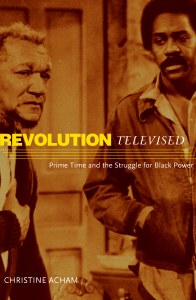
In Revolution Televised, Christine Acham offers a complex reading of African American television history, finding within programs like Sanford and Son and Good Times opposition to dominant white constructions of African American identity. Revolution Televised deftly illustrates how black television artists operated within the constraints of the television industry to resist and ultimately shape the mass media’s portrayal of African American life.
Revolution Televised is a brilliant, engaging, often eloquent book that offers a completely fresh take on black television in the seventies. Spurning the simplicity of ‘negative’ versus ‘positive’ images, it instead explores the complex forms of agency and resistance that black actors exercised, as well as probing the social circumstances and artistic options available to its creators. This is unquestionably the finest treatment of its subject that I have read, and will spark intense debate about the critical issues it raises for some time to come. A marvelous, poetic read!
Michael Eric Dyson, author of Mercy, Mercy Me: The Art, Loves, and Demons of Marvin Gaye
After a decade-long hiatus, African Americans once again began appearing regularly on television in the 1960s. Bill Cosby costarred on I Spy, Sammy Davis Jr. briefly hosted a variety show, and in 1968 Diahann Carroll debuted in the title role of Julia, the first television series to star an African American since the cancellation of Amos ’n’ Andy. Over the next ten years, shows with African American casts became more common; some, like Sanford and Son and Good Times, were hits with both black and white audiences. Yet many within the black community criticize these programs as perpetuating demeaning stereotypes and hampering the political progress made by African Americans.
In Revolution Televised, Christine Acham offers a more complex reading of this period in African American television history, finding within these programs opposition to dominant white constructions of African American identity. She explores the intersection of popular television and race as witnessed from the documentary coverage of the civil rights and Black Power movements, the personal politics of Flip Wilson and Soul Train’s Don Cornelius, and the ways in which notorious X-rated comedian Redd Foxx reinvented himself for prime time. Reflecting on both the potential of television to effect social change as well as its limitations, Acham concludes with analyses of Richard Pryor’s politically charged and short-lived sketch comedy show and the success of outspoken comic Chris Rock.
Revolution Televised deftly illustrates how black television artists operated within the constraints of the television industry to resist and ultimately shape the mass media’s portrayal of African American life.
Revolution Televised is a brilliant, engaging, often eloquent book that offers a completely fresh take on black television in the seventies. Spurning the simplicity of ‘negative’ versus ‘positive’ images, it instead explores the complex forms of agency and resistance that black actors exercised, as well as probing the social circumstances and artistic options available to its creators. This is unquestionably the finest treatment of its subject that I have read, and will spark intense debate about the critical issues it raises for some time to come. A marvelous, poetic read!
Michael Eric Dyson, author of Mercy, Mercy Me: The Art, Loves, and Demons of Marvin Gaye
It’s fucking great that someone recognizes and appreciates what we were doing during this important period in television history. Christine Acham gets it and spells it out. Got it?
Richard Pryor
Acham provides an in-depth, informative examination of the intersection of race, entertainment, and uplift ideology on primetime television. Well written, engaging, and insightful.
Journalism & Mass Communication Quarterly
Acham explores the growing black presence on mainstream television during the civil rights era and the power that representation afforded the black community to counteract white construction of black identity.
Material Culture
This work is vitally important to understanding how the Black Power and Arts movements, the Chitlin’ Circuit, and television history converged in the 1970s with mixed results.
Black Issues Book Review
The readers of this book will, no doubt, find much that is disturbing, unsettling, and painful—some things we would all rather forget. Acham’s Revolution Televised, however, deserves praise for being both elucidating and innovative. A must read.
Television Quarterly
Acham has written an understanding and insightful analysis of the period that is now old enough to allow some contextual thinking. The notes are as interesting as the text—don’t miss them. This study will raise eyebrows and make readers think.
Communication Booknotes Quarterly
Acham’s book is an important contribution to the analysis of television history. The portrayal of African American entertainers resisting corporate interests and racism is valuable for readers who seek to better understand television and African American culture.
MultiCultural Review
The work is accessible and pulled together quite well. It weaves together some important issues in popular culture, cultural history, and media studies; it tackles class differences in relation to concerns about representation in the African American community; it presents varying images of black womanhood and it takes to task the American claim of equal access and opportunity.
Left History
Contents
Acknowledgments
Introduction
1. Reading the Roots of Resistance Television of the Black Revolution
2. Was the Revolution Televised? Network News and Black Journal
3. What You See Is What You Get Soul Train and The Flip Wilson Show
4. This Ain’t No Junk Sanford and Son and African American Humor
5. Respect Yourself! Black Women and Power in Julia and Good Times
6. That Nigger’s Crazy The Rise and Demise of The Richard Pryor Show
Conclusion: Movin’ On Up Contemporary Television as a Site of Resistance
Notes
Bibliography
Index