Writing and Seeing Architecture
2008
•
Skip to content. | Skip to navigation
Christian de Portzamparc and Philippe Sollers
Translated by Catherine Tihanyi
Foreword by Deborah Hauptmann
A stimulating and surprising conversation between architecture and literature experts
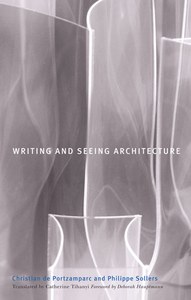
Writing and Seeing Architecture unveils a candid conversation between Christian de Portzamparc, celebrated French architect, and influential theorist Philippe Sollers that challenges us to see the analogous nature of writing and architecture. Their fascinating discussion offers a renewal of visionary architectural thinking by invoking past literary ideals that sought to liberate society through the reinvention of writing itself.
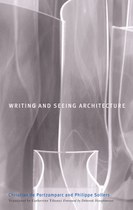
The creative forms of literature and architecture appear to be distinct, one constructing a world on the page, the other producing the world in which we live. It is a conscious act to read literature, but the effects of architecture can pass by unnoticed. Yet, despite such obvious differences, writers and architects share a dynamic with their readers and visitors that is unpredictably similar.
Writing and Seeing Architecture unveils a candid conversation between Christian de Portzamparc, celebrated French architect, and influential theorist Philippe Sollers that challenges us to see the analogous nature of writing and architecture. Their fascinating discussion offers a renewal of visionary architectural thinking by invoking past literary ideals that sought to liberate society through the reinvention of writing itself.
Urging that new rules be set for each creation rather than resorting to limitations of the capitalist society, the authors’ daring confrontation of the interactions between writing and designing a space forcefully demonstrates the importance of intellectuals and practitioners intervening in the public sphere.
$18.95 paper ISBN 978-0-8166-4568-8
$57.00 cloth ISBN 978-0-8166-4567-1
160 pages, 5 x 8, 2008
Christian de Portzamparc is an architect whose designs include the French Embassy in Germany, the Cité de la Musique in Paris, and the LVMH Tower in New York City.
He received the Pritzker Architectural Prize in 1994 and the Grand prix de l'urbanisme 2004 in France.
Deborah Hauptmann is associate professor of architecture theory at Delft University of Technology, The Netherlands. Her most recent publication is The Body in Architecture.
Catherine Tihanyi’s translations include One Must Also Be Hungarian by Adam Biro and The Story of Lynx by Claude Lévi-Strauss. She is a research associate in the Department of Anthropology at Western Washington University.
Philippe Sollers is a novelist and critic whose journal Tel Quel (1960–1982) published Jacques Derrida, Michel Foucault, and Bernard-Henri Lévy. He is the author of many books, including Watteau in Venice, Event and Women. He lives in Paris.
Contents
Foreword Deborah Hauptmann
Acknowledgments
1. Destruction
2. Can We Think without Language?
3. The Power of Dreams
4. Passion fixe
5. “Manufacturability”
6. Adventure of Language, Time, Body
7. Memories/Sleep
8. Intervention/Cézanne
Afterword: For the Musicians!
Notes
Architecture of Thought
An innovative examination of how material practices and constructed environments have shaped cultures
In the Scheme of Things
Alternative Thinking on the Practice of Architecture
One of the field’s most innovative thinkers reconsiders the purpose and practice of architecture
The Singular Objects of Architecture
A revelatory conversation between two major figures in visual culture
Sensory Design
A revolutionary approach to the built environment that embraces all of our senses and modes of understanding.
Utopia’s Ghost
Architecture and Postmodernism, Again
Unpacking architecture’s important—and continuing—role in postmodern thought
© 2011 University of Minnesota Press | Privacy Policy | The University of Minnesota is an equal opportunity educator and employer.