Untimely Beggar
Poverty and Power from Baudelaire to Benjamin
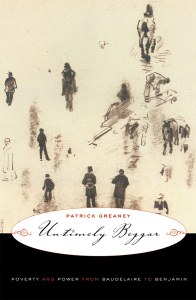
Covering the period from the publication of Les Fleurs du Mal in 1857 to the composition of Benjamin’s final texts in the 1930s, Untimely Beggar investigates the coincidence of two modern literary and philosophical interests: representing the poor and representing potential. In doing so, Patrick Greaney offers significant insights into modernity’s intense philosophical and literary interest in socioeconomic poverty.
Patrick Greaney offers strong and poignant readings that responsibly attend to the modern cast of destitution. Brilliant, unflinching, and calm, he opens a dossier on one of the most imposing dimensions of our modernity, combining a strong sensibility for the impoverishment of being with the gift for naming the ravages of world-historical insolvency.
Avital Ronell, NYU
This highly original book takes as its starting point a central question for nineteenth- and twentieth-century literature and philosophy: how to represent the poor?
Covering the period from the publication of Les Fleurs du Mal in 1857 to the composition of Benjamin’s final texts in the 1930s, Untimely Beggar investigates the coincidence of two modern literary and philosophical interests: representing the poor and representing potential. To take account of literature’s relation to the poor, Patrick Greaney proposes the concept of impoverished writing, which withdraws from representing objects and registers the existence of power. By reducing itself to the indication of its own potential, by impoverishing itself, literary language attempts to engage and participate in the power of the poor.
This focus on impoverished language offers new perspectives on major French and German authors, including Marx, Nietzsche, Mallarmé, Rilke, and Brecht; and makes significant contributions to recent debates about power and potential in thinkers such as Agamben, Deleuze, Foucault, Hardt, and Negri. In doing so, Greaney offers significant insights into modernity’s intense philosophical and literary interest in socioeconomic poverty.
Patrick Greaney offers strong and poignant readings that responsibly attend to the modern cast of destitution. Brilliant, unflinching, and calm, he opens a dossier on one of the most imposing dimensions of our modernity, combining a strong sensibility for the impoverishment of being with the gift for naming the ravages of world-historical insolvency.
Avital Ronell, NYU
Greaney’s readings are for the most part attentive, sensitive, and even creative. He brings his interpretive acumen to the table, offering detailed analyses of the prosodic elements and finer nuances of poetry. His book ultimately makes for a pleasurable read; its prose is lucid and engaging while its argument advances steadily and convincingly. Overall, the most admirable quality of Untimely Beggar is its consistent combination of traditional scholarship and newer critical approaches. Greaney mindfully attends to his predecessors, but simultaneously forges ahead in his own productive encounter with a host of diverse texts that exemplify his concept of impoverished writing.
German Studies Review
Greaney’s study is a bold initiative, scholarly and informative, and it brings together familiar themes, and familiar writers and theorists, in a constellation that generations significant new light.
French Studies