Tracking Modernity
India’s Railway and the Culture of Mobility
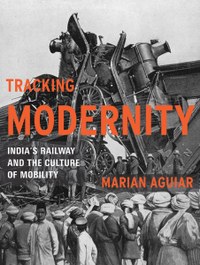
For centuries the railway has been one of India’s most potent emblems of modern life. In the first in-depth analysis of representations of the Indian railway, Marian Aguiar interprets modernity through the legacy of this transformative technology. Revealing railways as a microcosm of tensions within Indian culture, Aguiar demonstrates how their representations have challenged prevailing ideas of modernity.
In Tracking Modernity, Marian Aguiar demonstrates a compelling grasp of the complex discourses around and about India’s railway and its imbrication in the contested discourses of modernity, mobility, and migration. Aguiar offers both a panoramic and a concentrated view of the many modes of representation of the scene of the train, the spaces of the train, and the railway platform. Historically grounded, theoretically sophisticated, and clearly articulated, Tracking Modernity takes us on a journey through the Indian landscape as it changes from colonial depictions, to postcolonial destinations constantly underlining the violence and terror that the train conjures for the Indian imagination alongside its endless capacity for restless movement.
Sangeeta Ray, University of Maryland
From Mohandas Gandhi’s nineteenth-century tour in a third-class compartment to the recent cinematic shenanigans of Wes Anderson’s The Darjeeling Limited, the railway has been one of India’s most potent emblems of modern life. In the first in-depth analysis of representations of the Indian railway, Marian Aguiar interprets modernity through the legacy of this transformative technology.
Since the colonial period in India, the railway has been idealized as a rational utopia—a moving box in which racial and class differences might be amalgamated under a civic, secular, and public order. Aguiar charts this powerful image into the postcolonial period, showing how the culture of mobility exposes this symbol of reason as surprisingly dynamic and productive. Looking in turn at the partition of India, labor relations, rituals of travel, works of literature and film, visual culture, and the Mumbai train bombings of 2006, Aguiar finds incongruities she terms “counternarratives of modernity” to signify how they work both with and against the dominant rhetoric.
Revealing railways as a microcosm of tensions within Indian culture, Aguiar demonstrates how their representations have challenged prevailing ideas of modernity.
In Tracking Modernity, Marian Aguiar demonstrates a compelling grasp of the complex discourses around and about India’s railway and its imbrication in the contested discourses of modernity, mobility, and migration. Aguiar offers both a panoramic and a concentrated view of the many modes of representation of the scene of the train, the spaces of the train, and the railway platform. Historically grounded, theoretically sophisticated, and clearly articulated, Tracking Modernity takes us on a journey through the Indian landscape as it changes from colonial depictions, to postcolonial destinations constantly underlining the violence and terror that the train conjures for the Indian imagination alongside its endless capacity for restless movement.
Sangeeta Ray, University of Maryland
Tracking Modernity is an important and original work that grapples with the vast question of modernity in India via insightful readings of a range of cultural texts. Aguiar presents hers theoretical and cultural research in a clear and engaging way, making this book both scholarly and also incredibly enjoyable to read.
Journal of Postcolonial Writing
Tracking Modernity provides its readers with a fascinating analysis of the Indian railway’s salience in both the national and transnational cultural imaginary. It is an excellent addition to existing scholarship that positions transportation as an important means of understanding modernity.
Postcolonial Text
Tracking Modernity is to be welcomed for providing the first scholarly overview and analysis of a wide range of cultural representations of railways in colonial and postcolonial India.
Technology & Culture
A fascinating cultural exploration of the ways that trains shaped modern Indian society, it is also a sophisticated and multifaceted exploration of the deeply rooted connection between modernity and mobility. Tracking Modernity provides a crucial addition to the emerging fields of mobility and critical transport studies and to well-established debates about global modernity.
Cultural Critique
Tracking Modernity is a treat to the readers of metaphors. The craft of cultural studies enables the book to become a source for further research in sociology and anthropology. It is a lucid account even for readers without a substantial background in cultural studies.
South Asia: Journal of South Asian Studies
Tracking Modernity: India’s Railway and the Culture of Modernity did not disappoint. The singular achievement of this book is that it not only revisits the canon of Partition narratives through rigorous attention to a greater diversity of texts including film, but it also offers fine distinctions between the ways recent postcolonial fictions of community are influenced by the continuing presence of railways in India.
Reviews in Cultural Theory
In the hands of Marian Aguiar, the child of industrial revolution proves to be an ideal topic for cultural studies. The book weaves together ideological issues brought about by an imported technology, as well as a daily praxis, which continuously questions and very often debunks the faith in the modern idea of progress.
Modern Fiction Studies
There is much to admire in this finely wrought book. Tracking Modernity abundantly demonstrates that all categories (of nation, of race, of modernity, of thought itself) are subject to fissure, with their productive aspects being intimately linked to their undoing. To track modernity means not only to track such fissured terrain but also to excavate modernity’s counter-narratives, its tales that bid us beware. It could do a lot of good to attend carefully to the story Aguiar has to tell.
Interventions
Preface
Introduction: Tracking Modernity
1. The Permanent Way: Colonial Discourse of the Railway
2. The Machine of Empire: Technology and Decolonization
3. Partition and the Death Train
4. New Destinations: the Image of the Postcolonial Railway
5. Bollywood on the Train
Conclusion: Terrorism and the Railway
Acknowledgments
Notes
Bibliography
Filmography
Index