Theaters of Occupation
Hollywood and the Reeducation of Postwar Germany
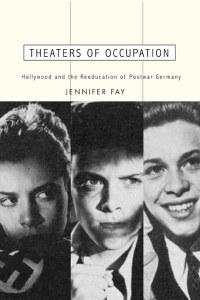
In a rigorous analysis of the American occupation of postwar Germany and the military’s use of “soft power,” Jennifer Fay considers how Hollywood films, including Ninotchka, Gaslight, and Stagecoach, influenced German culture and cinema. Theaters of Occupation reveals how Germans responded to these education efforts and offers new insights about American exceptionalism and virtual democracy at the dawn of the Cold War.
Jennifer Fay offers subtle and sophisticated readings of select films, amply demonstrating how self-contradictory and problematic the American concept of democratic re-education can be in the sphere of culture.
Thomas Elsaesser, author of European Cinema: Face to Face with Hollywood
In the aftermath of total war and unconditional surrender, Germans found themselves receiving instruction from their American occupiers. It was not a conventional education. In their effort to transform German national identity and convert a Nazi past into a democratic future, the Americans deployed what they perceived as the most powerful and convincing weapon—movies.
In a rigorous analysis of the American occupation of postwar Germany and the military’s use of “soft power,” Jennifer Fay considers how Hollywood films, including Ninotchka, Gaslight, and Stagecoach, influenced German culture and cinema. In this cinematic pedagogy, dark fantasies of American democracy and its history were unwittingly played out on-screen. Theaters of Occupation reveals how Germans responded to these education efforts and offers new insights about American exceptionalism and virtual democracy at the dawn of the Cold War.
Fay’s innovative approach examines the culture of occupation not only as a phase in U.S.–German relations but as a distinct space with its own discrete cultural practices. As the American occupation of Germany has become a paradigm for more recent military operations, Fay argues that we must question its efficacy as a mechanism of cultural and political change.
Jennifer Fay offers subtle and sophisticated readings of select films, amply demonstrating how self-contradictory and problematic the American concept of democratic re-education can be in the sphere of culture.
Thomas Elsaesser, author of European Cinema: Face to Face with Hollywood
Jennifer Fay, one of the more skillful practitioners of cultural studies, has produced a work of film history that should vindicate those sympathetic to new approaches to occupation regimes . . . . This work may even win over some traditionalists at odds with the cultural turn. They will find it accessible and full of insights into the culture of occupation, whether in postwar Germany or contemporary Iraq, as she probes not just routines of obedience but also ruses of resistance.
The Journal of American History
With great enthusiasm and an innovative approach, [Jennifer Fay] maps the attempt to produce in occupied Germany a democratic pedagogy through the use of cinematic culture, while simultaneously giving an intriguing insight to both German and American film production during the 1940s and 1950s.
Film International
Fay contributes new perspectives with her careful attention to film form and narration, her nuanced approach to the question of spectatorship, and her critique of the psychocultural and political assumptions driving film policy, if not the politics of Occupation as a whole.
H Soz U Kult
Fay’s volume is excellent—well researched, written and argued—and she provides the first scholarship to date on at least six of the films analyzed. Theaters of Occupation adds an essential piece to the field of transnational cinema.
German Quarterly Book Reviews
Jennifer Fay has produced an innovative, superbly researched, and engagingly written book on U.S.-led reorientation politics in the aftermath of World War II.
The Historical Journal of Radio, Television and Film
What’s most striking about Fay’s analysis is the facility with which she organizes insights drawn from a diverse array of disciplines—literary criticism, literary theory, film studies, political theory and history—into a coherent whole. It’s a very rich tapestry that she weaves.
Postmodern Culture
A fascinating study of cultural policy in the postwar U.S. zone of occupation.
Monatshefte
Theaters of Occupation is a well-written, well-researched, interdisciplinary study on the intersections between nationalism, identity, film and culture. It is an excellent read, one which scholars from a variety of disciplines, including media, cultural studies, film, international relations, political science, history, and German and American studies, will likely find enjoyable, interesting and useful.
International Journal of Media and Cultural Politics