Terror and Its Discontents
Suspect Words in Revolutionary France
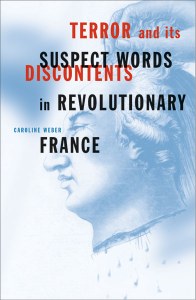
Terror and Its Discontents is a revealing look into the paradoxical embargo on free expression that underpinned the Robespierrists’s self-proclaimed “despotism of liberty” during the French Revolution. Caroline Weber provides a highly original—and timely—exposition of the political uses of rhetoric and of the links between language and power.
Terror and Its Discontents is an original and provocative analysis of revolutionary rhetoric. Focusing on questions of ‘discursive totality,’ Weber examines how the revolutionary desire to disclose ‘the entire truth’ also implied a large measure of linguistic repression.
Marie-Hélène Huet, author of Mourning Glory: The Will of the French Revolution
Camille Desmoulins, a journalist writing under the Montagnard regime of 1793-94, remarked that France’s government had replaced “the language of democracy” with “the cold poison of fear, which paralyzed thought in the bottom of people’s souls, and prevented it from pouring forth at the tribunal, or in writing.” How this happened, how the Reign of Terror reached even into the realms of thought and language, is the subject of Caroline Weber’s book, a revealing look into the paradoxical embargo on free expression that underpinned the Robespierrists’s self-proclaimed “despotism of liberty” during the French Revolution.
Weber examines Jean-Jacques Rousseau’s and the Robespierrists’s articulation of a series of initiatives designed to curtail and control the dissemination of alternative political and philosophical messages in the republic. Here Weber underscores the internal contradictions and limitations of an enterprise that promised universal freedom while oppressing particularism, and that railed against the very language that it was compelled to adopt as a principal political tool. The book then focuses on two eloquent contemporary critics of this phenomenon, Desmoulins and the Marquis de Sade, the infamous libertine author. Weber demonstrates how Desmoulins reconfigured the Montagnard regime’s rhetoric to conjure up a political system based on tolerance, not terror, and how Sade deftly parodied the Robespierrists’s brutality and hypocrisy, proposing a republic based on the ruthless elimination of dissident voices and on the unabashed celebration of despotism and bloodshed.
A balanced account of how the “discourse of totality” actually restricted particular freedoms in the wake of the French Revolution, this book provides a highly original—and timely—exposition of the political uses of rhetoric and of the links between language and power.
Terror and Its Discontents is an original and provocative analysis of revolutionary rhetoric. Focusing on questions of ‘discursive totality,’ Weber examines how the revolutionary desire to disclose ‘the entire truth’ also implied a large measure of linguistic repression.
Marie-Hélène Huet, author of Mourning Glory: The Will of the French Revolution