Speculative Security
The Politics of Pursuing Terrorist Monies
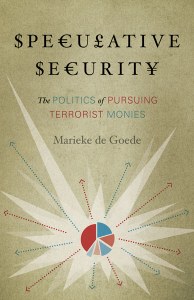
Since the terrorist acts of September 11, 2001, finance and security have become joined in new ways to produce particular targets of state surveillance. Marieke de Goede describes how previously unscrutinized practices such as donations and remittances have been affected by security measures, revealing how creating “security” appeals to multiple imaginable—and unimaginable—futures to enable action in the present.
While Afghanistan and Iraq grabbed the headlines, much of the ‘war on terror’ went on below the radar. Marieke de Goede has written a richly detailed and theoretically astute study which acts as a compelling and invaluable guide to the complicated world of terrorist and counter-terrorist finance.
Stuart Elden, author of Terror and Territory
Since the terrorist acts of September 11, 2001, finance and security have become joined in new ways to produce particular targets of state surveillance. In Speculative Security, Marieke de Goede describes how previously unscrutinized practices such as donations and remittances, especially across national borders, have been affected by security measures that include datamining, asset freezing, and transnational regulation. These “precrime” measures focus on transactions that are perfectly legal but are thought to hold a specific potential to support terrorism. The pursuit of suspect monies is not simply an issue of financial regulation, she shows, but a broad political, social, and even cultural phenomenon with profound effects on everyday life.
Speculative Security offers a range of examples that illustrate the types of security interventions employed today, including the extralegal targeting and breaking up of the al-Barakaat financial network that was accompanied by raids in the United States, asset freezes in Sweden, and the incarceration of a money remitter at Guantánamo Bay. De Goede develops the paradigm of “speculative security” as a way to understand the new fusing of finance and security, denoting the speculative nature of both the means and the ends of the war on terrorist financing.
Ultimately, de Goede reveals how the idea of creating “security” appeals to multiple imaginable—and unimaginable—futures in order to enable action in the present.
While Afghanistan and Iraq grabbed the headlines, much of the ‘war on terror’ went on below the radar. Marieke de Goede has written a richly detailed and theoretically astute study which acts as a compelling and invaluable guide to the complicated world of terrorist and counter-terrorist finance.
Stuart Elden, author of Terror and Territory
Speculative Security opens up the empirical terrain of terrorist monies and the designation and pursuit of those monies to the wide-ranging interdisciplinary constituency of academics who study money and finance. The book’s detailed and rich coverage of the way that the regulated financial sector, circuits of kinship, and charitable foundations are all drawn into the domain of security provides an exhaustive account of this terrain.
Paul Langley, Durham University
Marieke de Goede has written an interesting and informative book about the practices and politics of the pursuit of monies with alleged terrorist connections, particularly insofar as this pursuit has been conducted in the years since the World Trade Center and Pentagon attacks of September 2001.
Environment and Planning D: Society and Space
Like Foucault, Goede is relentlessly iconoclastic.
Choice
Speculative Security is a beautifully written, empirically and theoretically rich text on the neglected but crucial topic of terrorism finance.
Mona Atia, Political Geography
Marieke de Goede’s Speculative Security is a theoretically sophisticated and empirically rich analysis of the contemporary pursuit of terrorist monies.
Emily Gilbert, Political Geography
Like a great novel that elicits universal themes through the compelling engagement with a very precise and particular story, de Goede’s Speculative Security sets out a fascinating set of cases that illuminate some important and new dynamics about the configuration of global politics.
Mark B. Salter, Political Geography
Contents
Abbreviations
Acknowledgments
Introduction: The Politics of Terrorism Financing
1. Mediating Terrorist Money
2. The Finance–Security Assemblage
3. Following the Money: Risk, Preemption, and the Mobile Norm
4. Cash and the Circuits of Transnational Kinship
5. Zakat and the Securitization of Charitable Donation
6. Money and Modern Exile
Conclusion: Premediation and Contestation
Notes
Index