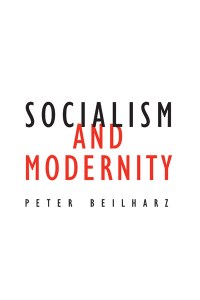
Socialism and Modernity
This first collection of Peter Beilharz’s highly influential thought traces the themes and problems, manifestations, and trajectories of socialism and modernity as they connect and shift over a twenty-year period. Woven throughout Beilharz’s analysis is the urgent question of modern utopia: how do we imagine freedom and equality in modernity?
We listen to the wise and learned voice of Peter Beilharz, one of Australia’s most significant social thinkers, weaving its way through the intellectual history of three decades of socialist decline. Beilharz explains how the problem of capitalism gave way to the problem of modernity, and the socialist solution to the enigma of the postmodern. We learn how the substance of socialist critique is part of Americanism as well. An intriguing and subtle collection of essays ranging over two decades, Socialism and Modernity speaks to our time.
Jeffrey C. Alexander, Yale University
This first collection of Peter Beilharz’s highly influential thought traces the themes and problems, manifestations, and trajectories of socialism and modernity as they connect and shift over a twenty-year period. Woven throughout Beilharz’s analysis is the urgent question of modern utopia: how do we imagine freedom and equality in modernity?
The essays in this volume explore the relationship between socialism and modernity across the United States, Europe, and Australia from the mid-1980s to the turn of the twenty-first century, a time that witnessed the global triumph of capitalism and the dramatic turn away from Marxism and socialism to modernity as the dominant perspective. According to Beilharz, we have seen the expansion of a kind of Weberian Marxism, with the concept of revolution giving way to the idea of pluralized forms of power and the idea of rupture giving way to the postmodern sense of difference. These changes come together with the discourse of modernism, both aesthetic and technological.
Socialism and modernity, Beilharz argues, are fundamentally interrelated. In correcting the conflation of Marxism, Bolshevism, and socialism that occludes contemporary political thinking, he reopens a space for discussion of what socialist politics might look like now—in the postcommunist–postcolonial-postmodern moment.
We listen to the wise and learned voice of Peter Beilharz, one of Australia’s most significant social thinkers, weaving its way through the intellectual history of three decades of socialist decline. Beilharz explains how the problem of capitalism gave way to the problem of modernity, and the socialist solution to the enigma of the postmodern. We learn how the substance of socialist critique is part of Americanism as well. An intriguing and subtle collection of essays ranging over two decades, Socialism and Modernity speaks to our time.
Jeffrey C. Alexander, Yale University
Peter Beilharz, co-founder of the lively and long-lasting Australian journal Thesis Eleven and author of many books on social theory, historical sociology, and cultural criticism, provides us here with a collection of insightful essays on post-Communist socialism, labor and social history, and social theory—all seen from the antipodean edge.
George Steinmetz, University of Michigan
This book is a timely analysis of the intimate connection of socialism and modernity, situated historically in a time where capitalism is still predominant.
Critical Sociology
The relevance of Beilharz’s exceedingly well-written and highly accessible essays—combinations of theoretically informed and oriented histories, analyses and commentaries that they are—is likely to continue to grow as time goes by.
Contemporary Sociology
Peter Beilharz is known in the academic fraternity as an insightful social thinker who has relentlessly contributed in the areas of communism, labourism, social democracy and social history – all connected subtly by the common thread of modernity.
International Sociology