Service Economies
Militarism, Sex Work, and Migrant Labor in South Korea
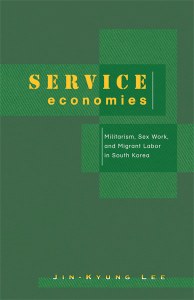
Service Economies examines how working-class labor occupies a central space in linking the United States and Asia to South Korea’s changing global position from a U.S. neocolony to a subempire. Foregrounding gender, sexuality, and race, Jin-kyung Lee reimagines the South Korean economic ‘miracle’ as a global and regional articulation of industrial, military, and sexual proletarianization.
Examining South Korean history since 1945, Service Economies highlights the role of sexualized and gendered working-class labor as an occluded but crucial part of South Korean modernization. A truly interdisciplinary project, Jin-kyung Lee’s ambitious, rigorous, and synthetic work intervenes into historical, political economic, and cultural studies scholarship on South Korea, transnational labor, gender and sexuality, and U.S. neo-colonialism.
Grace Hong, UCLA
Service Economies presents an alternative narrative of South Korean modernity by examining how working-class labor occupies a central space in linking the United States and Asia to South Korea’s changing global position from a U.S. neocolony to a subempire.
Making surprising and revelatory connections, Jin-kyung Lee analyzes South Korean military labor in the Vietnam War, domestic female sex workers, South Korean prostitution for U.S. troops, and immigrant/migrant labor from Asia in contemporary South Korea. Foregrounding gender, sexuality, and race, Lee reimagines the South Korean economic ‘miracle’ as a global and regional articulation of industrial, military, and sexual proletarianization.
Lee not only addresses these understudied labors individually but also integrates and unites them to reveal an alternative narrative of a changing South Korean working class whose heterogeneity is manifested in its objectification. Delving into literary and popular cultural sources as well as sociological work, Lee locates South Korean development in its military and economic interactions with the United States and other Asian nation-states, offering a unique perspective on how these practices have shaped and impacted U.S.–South Korea relations.
Examining South Korean history since 1945, Service Economies highlights the role of sexualized and gendered working-class labor as an occluded but crucial part of South Korean modernization. A truly interdisciplinary project, Jin-kyung Lee’s ambitious, rigorous, and synthetic work intervenes into historical, political economic, and cultural studies scholarship on South Korea, transnational labor, gender and sexuality, and U.S. neo-colonialism.
Grace Hong, UCLA
Service Economies is a well-written and highly readable work.
Korean Quarterly
This book is the first to analyse and explain through literature some of the deepest and most
traumatic experiences of those engaged in invisible labour in South Korea's transnational economy. It is a tour de force.
Intersections: Gender and Sexuality in Asia and the Pacific
A literary analysis that is nothing short of groundbreaking, Jin-Kyung Lee’s Service Economies is a must-read and a welcome addition to scholarly literature on contemporary South Korean society.
Review of Korean Studies
Contents
Acknowledgments
Introduction: Proletarianizing Sexuality and Race
1. Surrogate Military, Subempire, and Masculinity: South Korea in the Vietnam War
2. Domestic Prostitution: From Necropolitics to Prosthetic Labor
3. Military Prostitution: Gynocentrism, Racial Hybridity and Diaspora
4. Migrant and Immigrant Labor: Redefining Korean Identity
Postscript: The Exceptional and the Normative in South Korean Modernization
Notes
Bibliography
Index