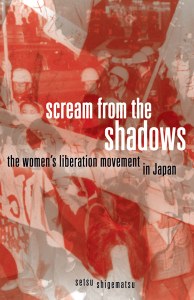
Scream from the Shadows
The Women’s Liberation Movement in Japan
Setsu Shigematsu’s book is the first to present a sustained history of the formation of ūman ribu—a women’s liberation movement in Japan—its political philosophy, and its contributions to feminist politics. Through an in-depth analysis of ūman ribu, Shigematsu furthers our understanding of Japan’s gender-based modernity and imperialism and expands our perspective on transnational liberation and feminist movements worldwide.
With Scream from the Shadows we at last have feminist voices from Japan that are not tethered to the Euro-American liberal tenets of area studies. Bracingly candid and self-reflective, Scream from the Shadows speaks directly to the post-9-11 moment of liberal feminism’s affinity with militarized and other modes of state violence. It dares us to make critical transnational feminist inquiries urgently relevant to all our ongoing transformative projects.
Lisa Yoneyama, Women and Gender Studies Institute, University of Toronto
More than forty years ago a women’s liberation movement called ūman ribu was born in Japan amid conditions of radicalism, violence, and imperialist aggression. Setsu Shigematsu’s book is the first to present a sustained history of ūman ribu’s formation, its political philosophy, and its contributions to feminist politics across and beyond Japan. Through an in-depth analysis of ūman ribu, Shigematsu furthers our understanding of Japan’s gender-based modernity and imperialism and expands our perspective on transnational liberation and feminist movements worldwide.
In Scream from the Shadows, Shigematsu engages with political philosophy while also contextualizing the movement in relation to the Japanese left and New Left as well as the anti–Vietnam War and radical student movements. She examines the controversial figure Tanaka Mitsu, ūman ribu’s most influential activist, and the movement’s internal dynamics. Shigematsu highlights ūman ribu’s distinctive approach to the relationship of women—and women’s liberation—to violence: specifically, the movement’s embrace of violent women who were often at the margins of society and its recognition of women’s complicity in violence against other women.
Scream from the Shadows provides a powerful case study of a complex and contradictory movement with a radical vision of women’s liberation. It offers a unique opportunity to reflect on the blind spots within our contemporary and dominant views of feminism across their liberal, marxist, radical, Euro-American, postcolonial, and racial boundaries.
With Scream from the Shadows we at last have feminist voices from Japan that are not tethered to the Euro-American liberal tenets of area studies. Bracingly candid and self-reflective, Scream from the Shadows speaks directly to the post-9-11 moment of liberal feminism’s affinity with militarized and other modes of state violence. It dares us to make critical transnational feminist inquiries urgently relevant to all our ongoing transformative projects.
Lisa Yoneyama, Women and Gender Studies Institute, University of Toronto
The most theoretically innovative book in the field of gender and women’s history in Japan... for the current decade.
Japan Forum
Setsu Shigematsu’s Scream from the Shadows, an English-language history of and theoretical reflection on the movement, ought to become a reference point for many of us. This is a very important work, written with the same passionate and searching intellectual and political integrity as its subjects lived their politics, and is a model of engaged, critical scholarship. The detailed history, unfamiliar to readers used to Anglophone histories of the New Left, is of great interest in itself; Shigematsu draws it into conversation with contemporary concerns.
Overland Magazine
Scream from the Shadows deepens understanding of Japan’s political development, expands the feminist canon, and offers alternative approaches for examining the ever-changing dynamics of social movements.
Journal of Japanese Studies
Scream from the Shadows should be read widely alongside feminist publications addressing contemporary feminism’s supposed ‘crisis.’ Interesting and challenging... rich but never overcrowded... it is indeed a ‘scream’ to break the monotony of allegations that knowledge of historical women’s movements are past all usefulness, and of contemporary writings about feminism that neglect or obscure its global histories.
The Year’s Work in Critical and Cultural Theory
Contents
Preface: Feminism and Violence in the Womb of Empire
Introduction: Ûman Ribu as Solidarity and Difference
I. Genealogies and Violations
1. Origins of the Other/Onna: The Violence of Motherhood and the Birth of Ribu
2. Lineages of the Left: Death and Reincarnation of a Revolutionary Ideal
II. Movements and Mediums
3. The Liberation of Sex, Onna, and Eros: The Movement and the Politics of Collective
Subjectivity
4. Ribu and Tanaka Mitsu: The Icon, the Center, and Its Contradictions
III. Between Feminism and Violence
5. Ribu’s Response to the United Red Army: Feminist Ethics and the Politics of Violence
Epilogue: Lessons from the Legacy
Acknowledgments
Notes
Index